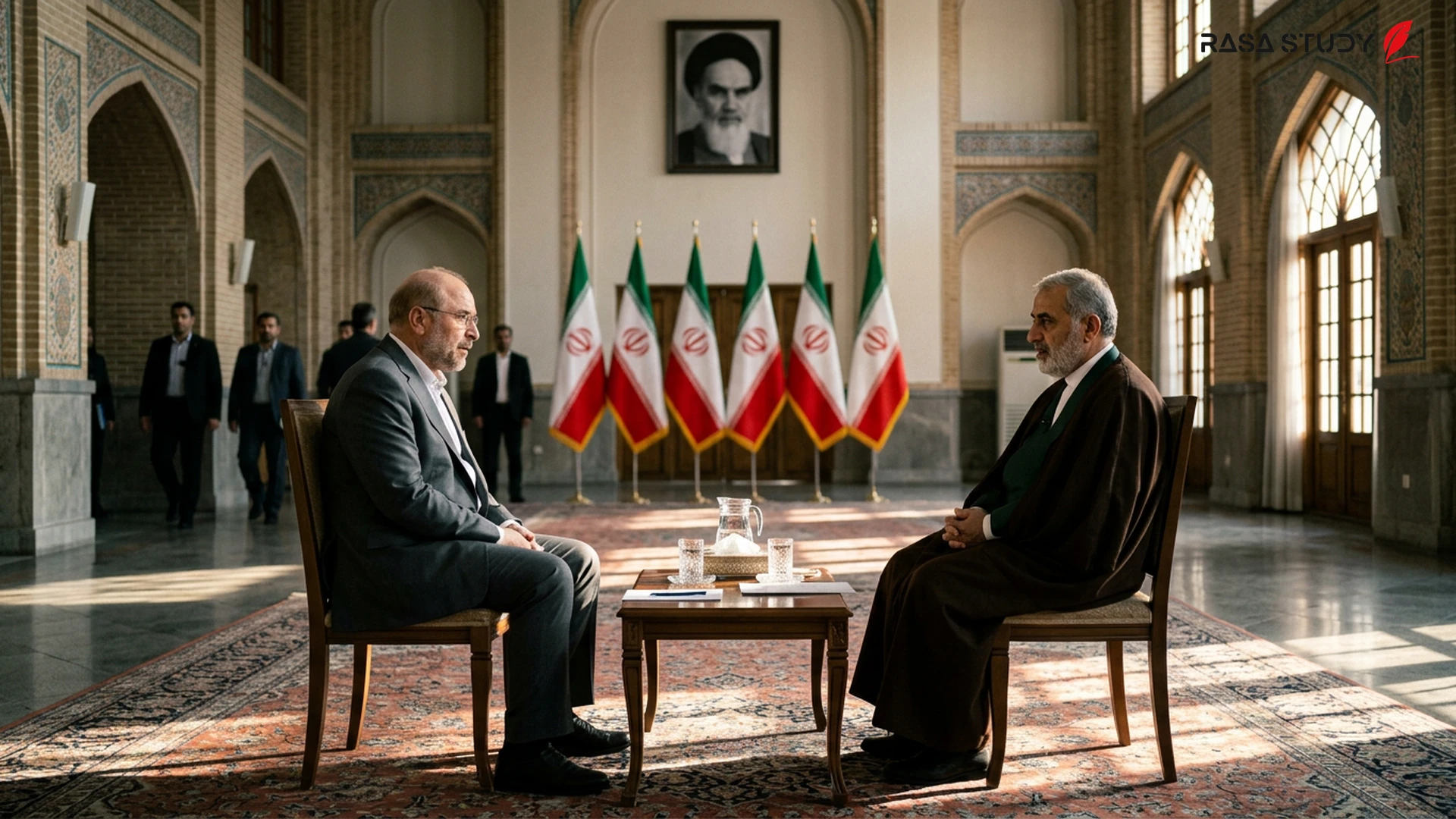
Mohammad Bagher Ghalibaf, Speaker of the Iranian Parliament, reaffirmed the Islamic Republic's unchangeable position on the non-recognition of Israel during an official meeting in Tehran. He noted that Tehran will continue its military and political support for the Resistance Front.
On July 5, 2026, Mohammad Bagher Ghalibaf, Speaker of the Parliament and head of Iran's negotiating team, delivered a decisive message to the international community and Tel Aviv during a key meeting with Mohammad Darwish, Chairman of the Hamas Council, in Tehran. Emphasizing that Iran will never recognize Israel, he stated that Tehran's support for the Resistance Front, including missile and political backing, will continue with full force [1][2]. These remarks come as the region faces complex post-war conditions and ongoing diplomatic negotiations.
Tehran's Unchangeable Stance on Israel During the meeting held in the Iranian capital, Ghalibaf stated: "We have no peace with the United States and we will not recognize Israel." Pointing out that diplomacy must be able to preserve and consolidate military achievements, he emphasized that the cause of liberating Al-Quds remains the primary priority of the Islamic Republic [1]. This explicit stance is seen as a response to recent speculation regarding a potential shift in Iran's foreign policy following ongoing talks with the West.
Support for the Resistance Front: Beyond Diplomacy The Speaker of the Iranian Parliament noted that the Islamic Republic will support the "Resistance Front" both militarily and politically if necessary. Mohammad Darwish also described the recent memorandum of understanding between Iran and the United States as a victory for the Resistance Front, claiming that the terms of this agreement indicate a retreat by Washington [2][3]. Meanwhile, tensions continue on the northern borders of Israel and Lebanon, and Iranian officials have warned against any new adventures.
Doha Negotiations and Challenges Ahead These sharp statements are made while representatives of Iran and the United States are engaged in technical consultations in Doha, Qatar, to maintain the ceasefire and manage the situation in the Strait of Hormuz [3]. However, Abbas Araghchi, Iran's Foreign Minister, recently issued a warning message stating that if Washington fails to restrain its allies in Tel Aviv, Tehran will provide a harsh response [3][4]. Iran's deep mistrust of American commitments remains the main obstacle to reaching a sustainable agreement.
Regional Context and Leadership Legacy Ghalibaf's words come at a time when Iran is mourning its late leader, Ayatollah Ali Khamenei. Iranian officials have emphasized that the new leadership will continue the same revolutionary path in strengthening Islamic unity and confronting the influence of extra-regional powers [4][5]. Masoud Pezeshkian, the President of Iran, also recently criticized the silence of international institutions regarding Israel's actions and called for greater solidarity among Muslim countries [4]. Ultimately, Tehran's message on July 5, 2026, appears to be an emphasis on the reality that despite economic pressures and diplomatic negotiations, the fundamental principles of Iran's foreign policy regarding Israel remain non-negotiable.
Mohammad Bagher Ghalibaf emphasized Iran's decisive position regarding Israel during a meeting with Mohammad Darwish.
linkSources
- İran'dan çok net İsrail mesajı: Resmi olarak tanımayacağız — Sabah (2026-07-05)
- İran'dan son dakika ABD ve İsrail açıklaması! 'Tanımayacağız' — Haber7 (2026-07-05)
- Iran warns of immediate response to any threat, cites US commitment — Al Arabiya (2026-07-01)
- Iranian officials warn US and Israel to honour commitments to end war — Dawn (2026-07-03)
- Net Assessment: The US-Iran Memorandum of Understanding — BESA Center (2026-07-05)


