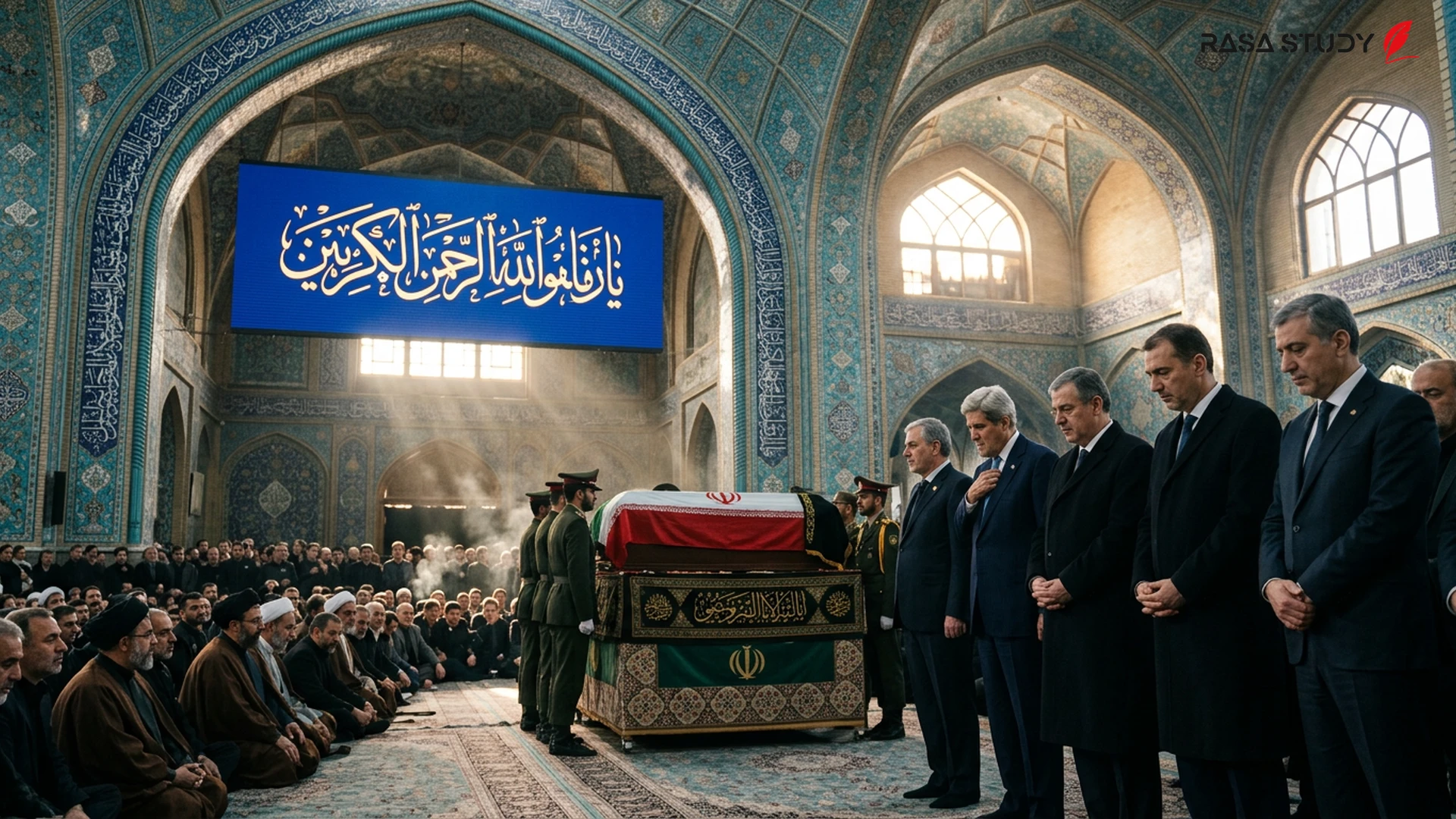
The funeral ceremony of Ayatollah Ali Khamenei in Tehran turned into a stage for aggressive diplomacy. Iranian officials broadcast sharp political messages, particularly against the positions of Turkey and Saudi Arabia, by reciting specific Quranic verses for each foreign delegation.
The Innovation of Quranic Diplomacy at the Tehran Musalla The funeral ceremony of Ayatollah Ali Khamenei, the former leader of the Islamic Republic who was killed following United States and Israeli airstrikes in February 2026, began today, July 4, in Tehran amid extensive diplomatic controversies [5]. In an unprecedented move, Iranian state media and the ceremony organizers at the Imam Khomeini Musalla recited a specific verse from the Holy Quran for each participating foreign delegation, which has been interpreted as Tehran's political statement toward those countries [1].
The ceremony, attended by representatives from more than 30 countries, became a tool for criticizing nations' stances regarding Iran's recent war rather than focusing solely on religious aspects. As Tehran attempts to demonstrate its authority after months of military conflict, the selection of these verses indicates the depth of diplomatic rifts in the region [4].
Verse 95 of Surah An-Nisa; A Sharp Innuendo at Turkey's "Neutrality" One of the most controversial parts of the ceremony was the recitation of Verse 95 of Surah An-Nisa during the presence of the high-ranking Turkish delegation led by Cevdet Yılmaz, the country's Vice President [3]. The verse states: "Not equal are those believers who sit [at home]—other than those otherwise disabled—and the mujahideen who strive in the cause of Allah with their wealth and their lives" [1].
Political analysts believe the choice of this verse is a direct and stinging criticism of Ankara's policies during the recent war. Iran expected Turkey, as a powerful neighbor, to provide more active military or political support to Tehran, but Ankara preferred to play the role of mediator and avoided direct entry into the tensions [2]. The term "Qa'idun" (those who sit) in this verse is seen as an allusion to Turkey's defensive and inactive approach toward the American and Israeli attacks [3].
Saudi Arabia and the Recital of the Battle of Badr In addition to Turkey, the Saudi Arabian delegation also faced a sharp message. For the Saudi delegation led by Waleed Al-Khereiji, Verse 13 of Surah Al-Imran was recited, which refers to the Battle of Badr [1]. This verse describes the confrontation between two groups: "One party fighting in the cause of Allah and another of disbelievers" [3].
The selection of this verse for Saudi Arabia, which has had volatile relations with Tehran in recent years, indicates the continuation of deep-seated mistrust. Implicitly placing Saudi Arabia in the camp opposite the "cause of Allah" reflects Tehran's anger over Riyadh's possible cooperation with the Western coalition during the February conflicts [4].
Funeral in the Shadow of War and Crisis This ceremony is held while Iran grapples with a severe economic crisis and ongoing security threats. The choice of July 4 (U.S. Independence Day) for the start of the funeral is considered a symbolic message to Washington [5]. While the crowd at the Musalla chanted anti-American slogans, the use of Quranic verses for diplomatic criticism showed that Tehran intends to use every tool to redefine its position in the new regional order after the war [2]. The funeral procession is scheduled to continue in the coming days in the cities of Qom, Najaf, and Karbala, with his body eventually being buried in Mashhad [5].
Presence of diplomatic delegations at the funeral of Iran's former leader at the Imam Khomeini Musalla in Tehran, July 2026.
linkSources
- İran, Hamaney'in cenazesinde her bir yabancı heyet için ayrı ayet okuttu: Türkiye'ye eleştiri var — T24 (2026-07-04)
- Hamaney'in cenazesinde diplomatik ayetler: İran'dan Türkiye'ye örtülü Nisa Suresi eleştirisi — Muhalif (2026-07-04)
- Saudi delegation's Khamenei tribute overshadowed by controversial Quran verse — Iran International (2026-07-03)
- Hamaney'in cenaze töreninde hangi mesajlar verildi? — Gazete Oksijen (2026-07-04)
- State funeral of Ayatollah Ali Khamenei — Wikipedia (2026-07-04)


