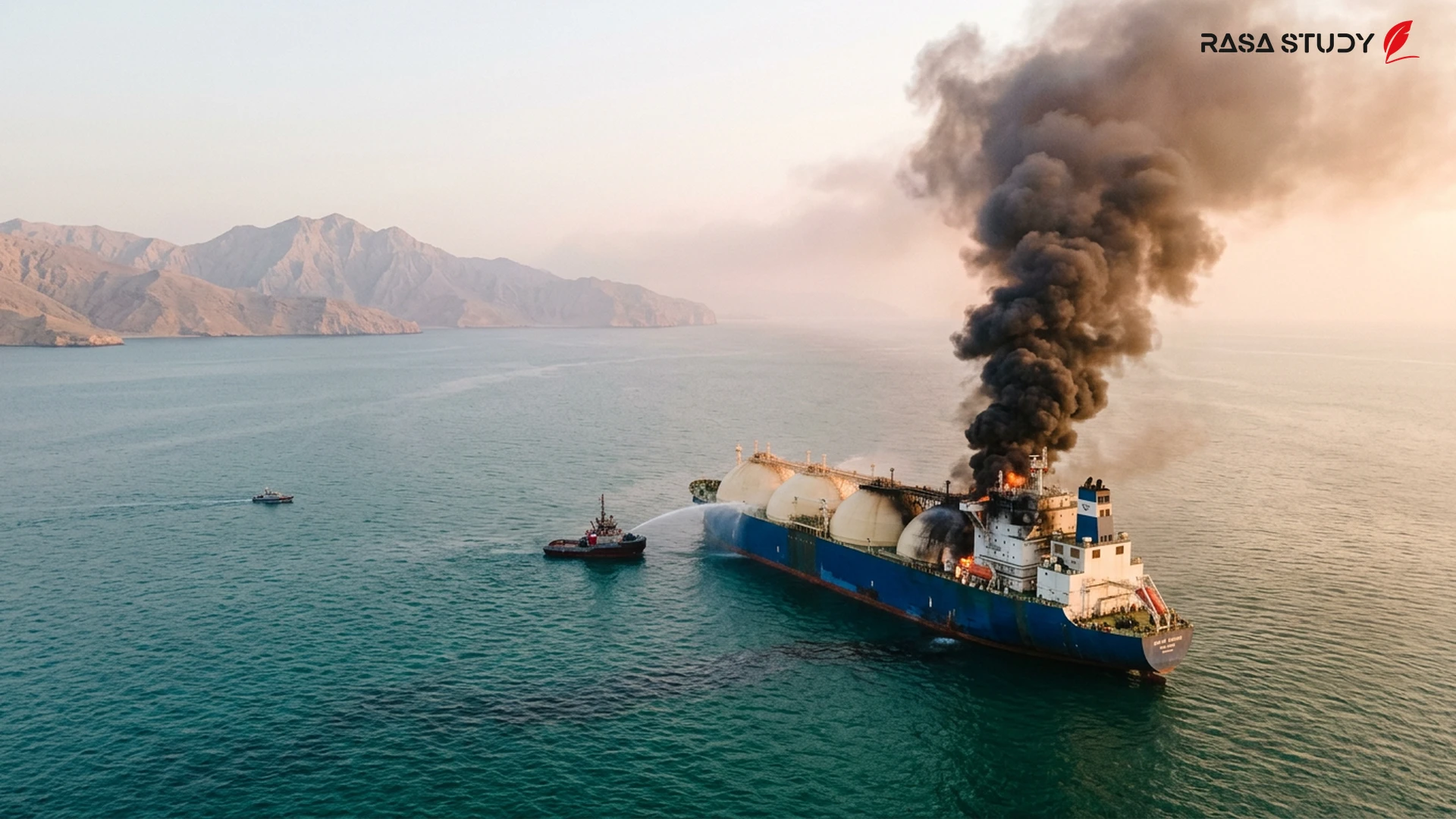
On July 7, 2026, the Strait of Hormuz once again became a scene of military conflict. The Iranian Navy fired a missile at a Qatari tanker, causing a fire on the vessel and a sudden spike in global oil prices.
Details of the Attack on the Tanker 'Al-Rekayyat' in the Strait of Hormuz Early this morning, July 7, 2026, multiple reports emerged of a severe military engagement in the Strait of Hormuz. According to data from the United Kingdom Maritime Trade Operations (UKMTO), the Qatari tanker 'Al-Rekayyat,' carrying Liquefied Natural Gas (LNG), was targeted by an unidentified projectile 8 miles east of the Lima region off the coast of Oman [1]. The attack caused a fire in the ship's engine room, but reports indicate that all crew members are safe and have been moved to the vessel's citadel [3].
Turkish news sources, including 'Para Analiz' and the Anadolu Agency, reported that the attack was carried out by the Islamic Revolutionary Guard Corps (IRGC) Navy [2]. In addition to the Qatari tanker, reports have also surfaced regarding damage to another vessel flying the Saudi Arabian flag named 'Wadyan,' indicating the broad scope of this military operation in one of the world's most strategic waterways [4].
Iran's Claim: Disregarding Sovereign Warnings Iranian state media, while implicitly confirming the incident, announced that the tanker was targeted for ignoring repeated warnings from Iranian naval forces. Iranian state television claimed that the Al-Rekayyat intended to pass through the Omani route in the Strait of Hormuz with the support of the United States Navy, despite Tehran's prior warnings that all vessels must use routes designated by Iran [1][3].
This conflict occurred just one day after the UKMTO announced that the southern corridor of the Strait of Hormuz could be used without the need for coordination with Iran; a statement that clearly contradicted Tehran's sovereign claims [2]. Iranian Foreign Minister Abbas Araghchi also stated in a message that final negotiations with Washington would not begin as long as threats continue [1].
Diplomatic Standoff and Risk of Military Retaliation This incident occurs only weeks after the signing of a Memorandum of Understanding (MOU) between Tehran and Washington, which was intended to halt attacks on commercial shipping [5]. With the expiration of the one-week temporary ceasefire and the deadlock in indirect talks in Doha, the shadow of war once again looms over the region. U.S. officials speaking to Axios stated that the United States is likely to respond militarily to Iranian targets in the region [3].
Simultaneously with these tensions, Iran is holding funeral ceremonies for its late leader, which has also inflamed the domestic political atmosphere [4]. Experts believe this display of military power in the Strait of Hormuz is a direct message to the U.S.-led international coalition on the eve of the NATO summit in Ankara [1].
Economic Consequences and Oil Price Spike Immediately following the news of the attack, Brent crude oil prices saw a significant increase, reaching the $73 per barrel mark [4]. Analysts warn that continued insecurity in the Strait of Hormuz, through which one-fifth of the world's oil passes, could drive prices back above $100 and confront the global energy supply chain with a serious crisis [5].
The Qatari tanker Al-Rekayyat caught fire after being hit by a missile near the coast of Oman.
linkSources
- İran basını: Hürmüz Boğazı yakınlarında uyarıları dikkate almayan bir petrol tankeri vuruldu — TRT Haber (2026-07-07)
- Iran targets 2 vessels in Strait of Hormuz: Report — Anadolu Agency (2026-07-07)
- Iran said to fire at 2 commercial ships in Hormuz, including Qatari gas tanker — The Times of Israel (2026-07-07)
- Oil prices climb over fears of renewed risk to vessels in Strait of Hormuz — The National (2026-07-07)
- Strait of Hormuz crisis 2026 — Britannica (2026-07-02)


