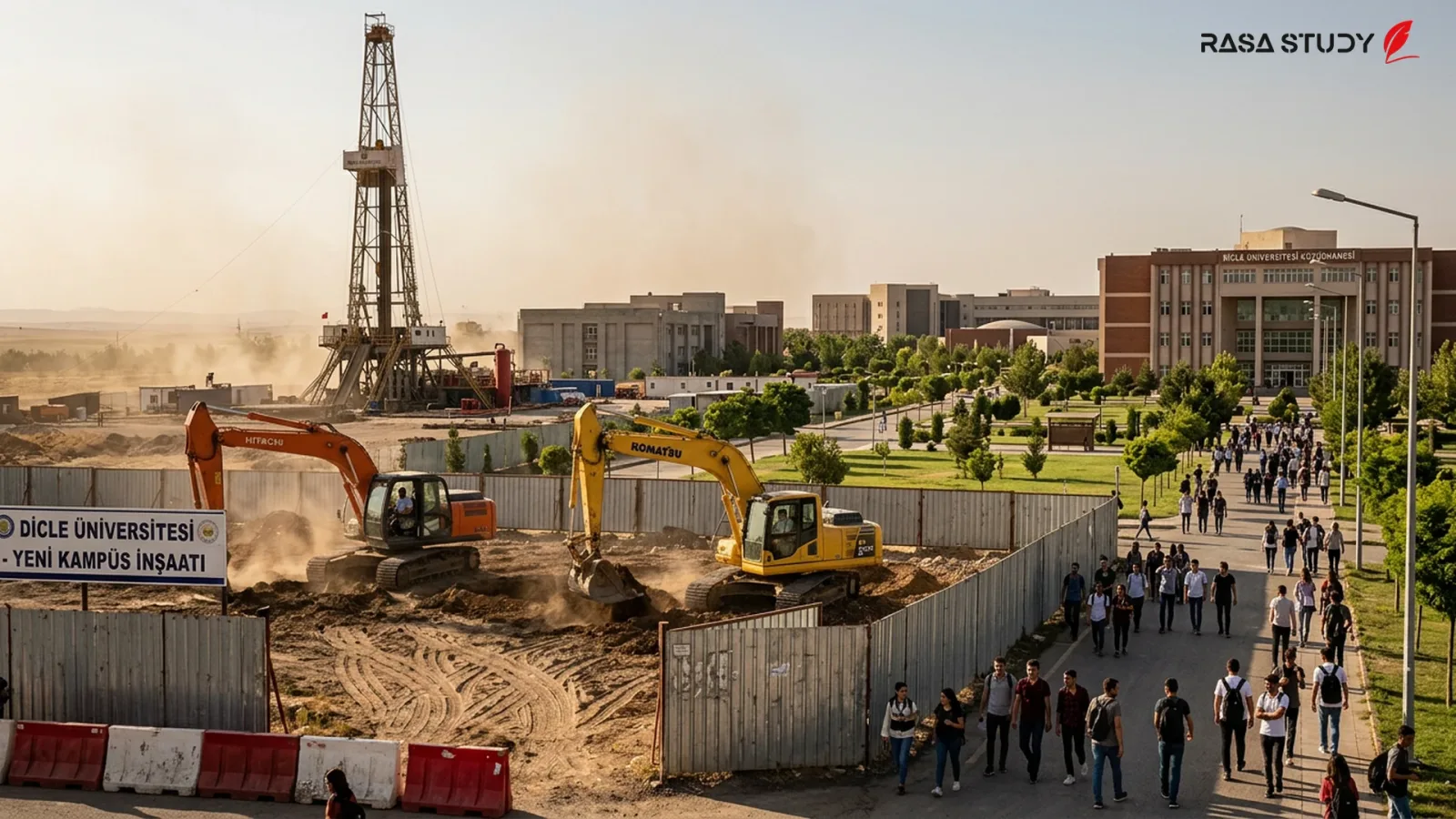
Alparslan Bayraktar, Turkey's Minister of Energy and Natural Resources, has officially confirmed that oil exploration and extraction operations will begin on the campus of Dicle University in Diyarbakır. This controversial project involves a $20 million investment.
Today, June 24, 2026, official reports indicate that the Turkish government has taken the final steps to transform part of the Dicle University campus into an active oil field. Alparslan Bayraktar, Minister of Energy and Natural Resources, confirmed in response to parliamentary inquiries that the necessary permits for drilling on university lands have been issued and executive operations will begin soon [1].
Contract Details and University Economic Share According to published information, an area of approximately 45,000 square meters on the Dicle University campus has been designated for this project. These lands have been leased to PETAR, a subsidiary of SANKO Holding [2]. It is anticipated that 6 oil wells will be drilled in this phase of operations, with the total project cost estimated at approximately $20 million. According to the agreement, the contract is set for a 10-year period, and Dicle University will receive only 3% of the net revenue from oil sales after deducting government and operational costs [3][5].
Political Reactions and Public Concerns This decision has met with sharp reactions from some members of parliament and civil activists. Serhat Eren, a Diyarbakır representative from the DEM Party, questioned the transparency and public interest of this project by submitting a question to the Grand National Assembly of Turkey. He pointed out that transferring the lands of a public educational institution to a private company for heavy industrial activities contradicts the principles of accountability and transparency [4]. Critics believe that the university's 3% share is negligible compared to the potential environmental destruction and the change in the use of educational space.
Technical Measures and Environmental Protection Defending the plan, the Energy Minister announced that the General Directorate of Mining and Petroleum Affairs (MAPEG) has conducted precise technical and geological evaluations. Bayraktar emphasized that special measures have been taken to prevent the contamination of groundwater resources [1]. These measures include the use of protective casing pipes to a depth of 650 meters and cementing the walls to prevent drilling mud from contacting water layers [3]. However, environmental experts continue to warn about the long-term effects of oil extraction near residential and educational areas.
Upon completion of the drilling, each well is expected to produce an average of 150 barrels of crude oil per day, bringing the total annual production to over 300,000 barrels [5]. This project is part of Turkey's macro-strategy to reduce dependence on energy imports, although the choice of a university environment for such activity remains a subject of heated debate in the Turkish media.
The Turkish Ministry of Energy confirmed that oil drilling operations on Dicle University land will begin in compliance with technical standards.
linkSources
- Bakan doğruladı: Üniversite kampüsünde petrol aranacak — BirGün (2026-06-23)
- Üniversite kampüsünde petrol arama doğrulandı: Dicle Üniversitesi arazisi şirkete açıldı — Evrensel (2026-06-23)
- Dicle Üniversitesi kampüsünde petrol aranacak — Artı Gerçek (2026-06-23)
- Enerji Bakanı Bayraktar da doğruladı: Üniversiteye petrol kuyusu! — Cumhuriyet (2026-06-23)
- Oil reserves discovered on university campus in southeastern Türkiye — Hürriyet Daily News (2026-04-30)


