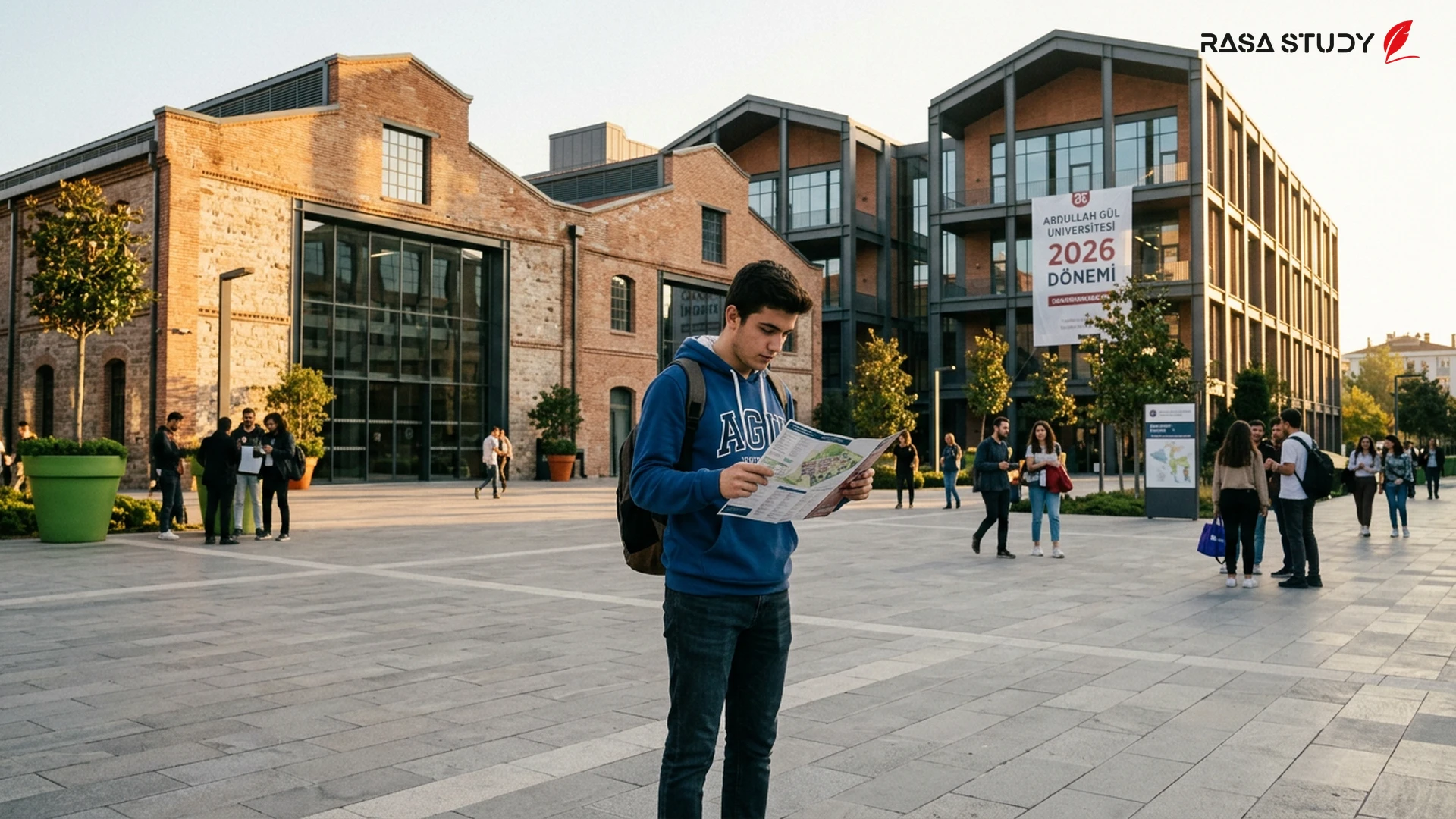
Studying in Turkey is an ideal destination for Iranian students due to the high quality of education and affordable costs. By being aware of the new rules of 2026, navigate your educational migration path with confidence.
Studying in Turkey has become one of the most popular educational migration destinations due to the high quality of education, cultural and geographical proximity to Iran, affordable costs compared to European and American countries, and the possibility of studying in both English and Turkish. However, the rules and conditions for Turkey university admission undergo changes every year, and a lack of awareness of them can pose serious challenges to your migration path.
In 2026, with the stabilization of the centralized TR-YÖS exam and the updating of public and private university tuitions, having a precise roadmap is more important than ever. If you dream of studying medicine, dentistry, engineering, or humanities at top universities in Istanbul, Ankara, or Izmir, this article is written for you.
In this evergreen and comprehensive guide prepared by senior experts at "Rasa Study", we review from A to Z the conditions, documents, exams, costs, and application steps for the 2026 academic year.
---
1. Conditions for Turkey University Admission by Academic Level
Turkey's educational system complies with the Bologna Process and European standards; therefore, degrees issued by universities in this country are highly recognized throughout Europe and the world. Admission conditions vary depending on the academic level:
Admission to Bachelor's Degree (Undergraduate, Medicine, and Dentistry) To enter the undergraduate level, which usually takes 4 years (and 5 years for dentistry and 6 years for medicine), international applicants have two general paths ahead: * Public Universities: Competition in these universities is very high. For admission, having a passing score in entrance exams such as TR-YÖS (Centralized YÖS Exam) or SAT is mandatory. Also, the high school diploma and pre-university (or 12th grade) GPA plays an important role in the final evaluation. * Private Universities: Many reputable private universities in Turkey (which are also approved by the Iranian Ministries of Science and Health) have provided the possibility of admission without an exam and solely based on academic records (high school diploma GPA).
Admission to Master's Degree (Graduate) The Master's degree program in Turkey usually takes 2 years and is offered in two forms: "with thesis" (Tezli) and "without thesis" (Tezsiz). * Main conditions: Presenting a valid Bachelor's degree with an acceptable GPA (usually above 14 or 15 out of 20 depending on the university). * Entrance exams: For public universities and some top private universities, presenting an ALES exam score (for Turkish-taught programs) or GRE / GMAT (for English-taught programs) is mandatory. * Other requirements: A strong Statement of Purpose (SOP), letters of recommendation from previous professors, and an academic resume (CV). In many fields, an academic interview (in-person or online) is also part of the admission process.
Admission to Doctorate Degree (PhD) Studying for a PhD in Turkey takes between 3 to 5 years and requires a strong academic background. * Main conditions: A relevant Master's degree with a high GPA. * Exams: A high score in the ALES exam (at least 55 to 60) or its equivalent in GRE/GMAT. Also, presenting a language certificate (TOEFL or YDS/YÖKDİL) is mandatory. * Proposal and interview: Having a detailed research proposal and convincing the faculty board in the interview session is the main key to getting admission to a PhD program. Having reputable articles (ISI) greatly increases your chances.
---
2. Entrance Exams for Applying to Turkish Universities
To get admission to a Turkish university, familiarity with the country's standardized exams is essential. In 2026, the structure of the exams is as follows:
Centralized TR-YÖS Exam Until a few years ago, each public university held its own specific YÖS exam. But the Turkish Assessment, Selection and Placement Center (ÖSYM) replaced it with the centralized TR-YÖS exam to make the process fairer. * Exam content: 80 questions including intelligence (IQ), geometry, and mathematics. * 2026 Exam Date: According to the official announcement of ÖSYM, the first stage of the TR-YÖS exam in 2026 will be held on April 12, 2026 (Farvardin 23, 1405). Registration for this exam was done from January 14 to February 3, 2026. * Validity: The result of this exam is valid for 2 years and is mandatory for admission to most public universities in Turkey.
SAT Exam The SAT is an American standardized test conducted in English. Many top universities in Turkey (such as Koç, Boğaziçi, METU, and Bilkent) use the SAT score as a criterion for admitting international students. This exam includes mathematics and English reading comprehension sections. The minimum required score is usually above 1200 (out of 1600), but for medical fields, you will need scores above 1400.
Language Exams (English and Turkish) * Turkish Language (TÖMER): If you intend to study in Turkish, you must provide a TÖMER certificate with a B2 or C1 level. * English Language (TOEFL): To study in English, a TOEFL iBT certificate with a score usually above 75 to 80 is required. Important note: Due to the rules of the Turkish Council of Higher Education (YÖK), many public universities in Turkey do not accept the IELTS certificate and prefer TOEFL. * Hazırlık (Preparation) Course: If you do not have a language certificate at the time of applying, don't worry. Most universities give you "conditional admission". You can participate in the university's language placement (exemption) exam, and if you do not pass, you will study for one year in the university's language preparation course (Hazırlık).
---
3. Required Documents for Turkey University Admission
Careful preparation of documents is one of the most important stages of applying. Incomplete documents can lead to the rejection of your application. The general list of documents for 2026 is:
- Valid Passport: With at least 6 months of validity.
- Personal Photo: A recent biometric photo with a white background.
- Educational Documents: Original high school and pre-university diplomas (for Bachelor's) or original degrees of previous levels (for Master's and PhD).
- Transcripts: Official transcripts of all years of the previous level.
- Language Certificate: TOEFL, TÖMER, or other valid certificates (if any).
- Entrance Exam Results: TR-YÖS, SAT, GRE, or ALES scorecard (depending on the field and university).
- Statement of Purpose (SOP): A text showing your purpose for choosing the field, university, and the country of Turkey (mostly for Master's, PhD, and scholarships).
- Letter of Recommendation (LOR): At least two letters from previous professors (for graduate studies).
- Application Fee Payment Receipt: If requested by the university (usually between $50 to $100).
---
4. Translation, Authentication, and Denklik of Documents
Your Iranian documents have no validity in Turkey on their own and must go through the following legal steps:
Official Translation and Notary (Noter) All educational and identity documents must be translated by an official translator into Turkish or English (depending on the university's language of instruction). After translation, the documents must be approved by the Judiciary and the Ministry of Foreign Affairs of Iran. In Turkey, making certified copies of documents is done in notary public offices, which are called "Noter".
Embassy Authentication (Apostille) Both Turkey and Iran are members of the Apostille Convention. You can get an Apostille stamp or have the translated documents authenticated by the Turkish Embassy or Consulate in Iran so that they gain legal status in Turkey.
Denklik (Equivalency of Educational Certificate) "Denklik" means a certificate of equivalency. All students who intend to study for a Bachelor's degree in Turkey must prove that their high school diploma is equivalent to a Turkish high school diploma. This is done through the e-Denklik system and the Turkish Ministry of National Education (MEB). Without a Denklik document, your final registration at the university will be canceled.
---
5. Application Deadlines for Turkish Universities in 2026
Timing is crucial in the application process. The academic year in Turkey usually starts in late September (Mehr).
- Public Universities: The application period is usually from April to July 2026. Each university has its own specific calendar. For example, top universities like METU or Koç usually have Early Application deadlines in March and May.
- Private Universities: Admission to private universities is more flexible and they usually accept students from January to August 2026 (on a Rolling Admission basis). However, for highly demanded fields like medicine and dentistry, capacities fill up quickly in the spring months.
- Turkish Government Scholarship (Türkiye Bursları): It is Turkey's largest fully-funded program that covers tuition fees, accommodation, insurance, and a monthly stipend. Registration for this scholarship for 2026 was done from January 10 to February 20, 2026.
---
6. Cost of Studying and Living in Turkey (Actual 2026 Figures)
One of the main questions of applicants is the issue of costs. Due to the fluctuations of the Turkish Lira, universities and reliable international sources usually calculate and announce costs based on the US Dollar (USD) to have more stability.
University Tuition Fees in 2026 * Public Universities: The tuition of these universities is very cheap. For non-medical fields (engineering, management, art), it is usually between $300 to $1,500 per year. For medical and dentistry fields, this amount varies between $2,000 to $6,000 per year. * Private Universities: The tuition of private universities is higher, but they do not require a difficult entrance exam. In 2026, the tuition for engineering, humanities, and management fields is between $3,200 to $9,000 per year. For medicine, dentistry, and pharmacy fields, tuitions vary from $12,500 to $44,000 per year (in ultra-luxury universities like Koç or Acıbadem).
Student Living Costs The cost of living in Turkey depends on the city you choose and your lifestyle. Istanbul is the most expensive city in Turkey, while Ankara, Izmir, and student cities like Eskişehir are cheaper. On average, a student in 2026 needs $300 to $600 per month to cover the following expenses: * Rent for housing or dormitory: $150 to $350 per month. * Food and groceries: $100 to $200 per month (using the university cafeteria greatly reduces costs). * Transportation: With a student card (Istanbulkart, etc.), about $15 to $25 per month. * Health Insurance: About $100 to $300 annually (mandatory for renewing the student residence permit).
---
7. Choosing a Major and University: Public or Private?
Choosing between a public and private university depends on your budget, time, and academic resume.
Why a public university?
If you have a strong academic foundation, have dedicated enough time to study and participate in the TR-YÖS or SAT exam, and want to get a valid degree at the lowest possible cost, public universities (such as Istanbul University, Ankara University, METU, Ege, and Dokuz Eylül) are the best choice.
Why a private university?
If you want to enter university without the stress of competitive exams, intend to study in English, and have enough budget to pay the tuition, private universities (such as Bahçeşehir, Aydın, Medipol, Yeditepe, and Atlas) are excellent options. These universities offer ultra-modern laboratory facilities, student exchange programs with Europe (Erasmus+), and less crowded classes.
---
8. Common Mistakes in the Turkey University Application Process
In the process of getting admission to a Turkish university, many students make mistakes due to ignorance that waste their time and money:
1. Trusting false promises: Advertisements like "Guaranteed medical admission in a public university without an exam" are complete scams. Entering public universities in medical fields is only possible through exams and academic competition.
2. Missing deadlines: Postponing the application to the last days of summer, especially for private universities, causes the capacity of popular fields to fill up or you miss out on Early Bird discount scholarships.
3. Ignoring the approval of the Iranian Ministries of Health/Science: If you intend to return to Iran and work after graduation, you must choose a university that is on the list of approved universities by the Iranian Ministry of Health or Ministry of Science in the 2026-2027 academic year.
4. Incomplete Denklik process: Many students enter Turkey without getting their high school diploma equivalency certificate and face legal problems and the risk of deportation during the final university registration.
---
9. The Role of an Educational Consultant and "Rasa Study" Services
The Turkey university admission process, from choosing the right university for your conditions to translating documents, registering for exams, getting admission, obtaining a student visa, and finally in-person registration and receiving a residence card (Kimlik), is a complex path full of legal details.
At Rasa Study (rasastudy.com), as an international education consulting center based in the heart of Istanbul, we pave this path for you. Our services include:
* Free consultation and resume evaluation: Careful review of your conditions and suggesting the best universities.
* Getting admission with the highest discount: Due to Rasa Study's official contracts with top private universities in Turkey, we can get your admission with tuition discount scholarships (from 25% to 75%).
* Handling administrative affairs from A to Z: From registering for the TR-YÖS exam to getting the Denklik certificate, booking a dormitory, and accompanying you in the process of getting a student residence permit.
With the help of a professional team, you only focus on your educational goal and will not have to worry about administrative bureaucracy.
---
10. Frequently Asked Questions (FAQ)
1. Is Turkey university admission without an exam real? Yes, but only for private universities and some specific programs in lower-tier public universities. Reputable private universities in Turkey accept students based on academic records (high school diploma GPA) and do not require a YÖS or SAT exam.
2. How much does it cost to study medicine in Turkey? In 2026, studying medicine in public universities costs between $2,000 to $6,000 annually (requires passing an exam). In private universities, this amount varies between $12,500 to $44,000 per year without the need for an exam.
3. What is the TR-YÖS exam and when is it held? The TR-YÖS exam is a national centralized exam for foreign students to enter public universities in Turkey, which has replaced the individual YÖS exams of universities. The first stage of this exam in 2026 will be held on April 12 (Farvardin 23).
4. Is a language certificate mandatory to study in Turkey? No, it is not mandatory for the first day. If you do not have a language certificate (TÖMER for Turkish or TOEFL for English), the university will give you a placement test. If you do not pass, you will participate in a one-year language preparation course (Hazırlık) at the university itself and then enter your main major.
5. What is Denklik and how to get it? Denklik is an educational certificate (diploma) equivalency certificate that shows your previous education matches the standards of the Turkish Ministry of Education. This certificate can be obtained by registering a request in the e-Denklik system and visiting the Turkish Embassy in Iran or the National Education Directorates (MEB) inside Turkey.
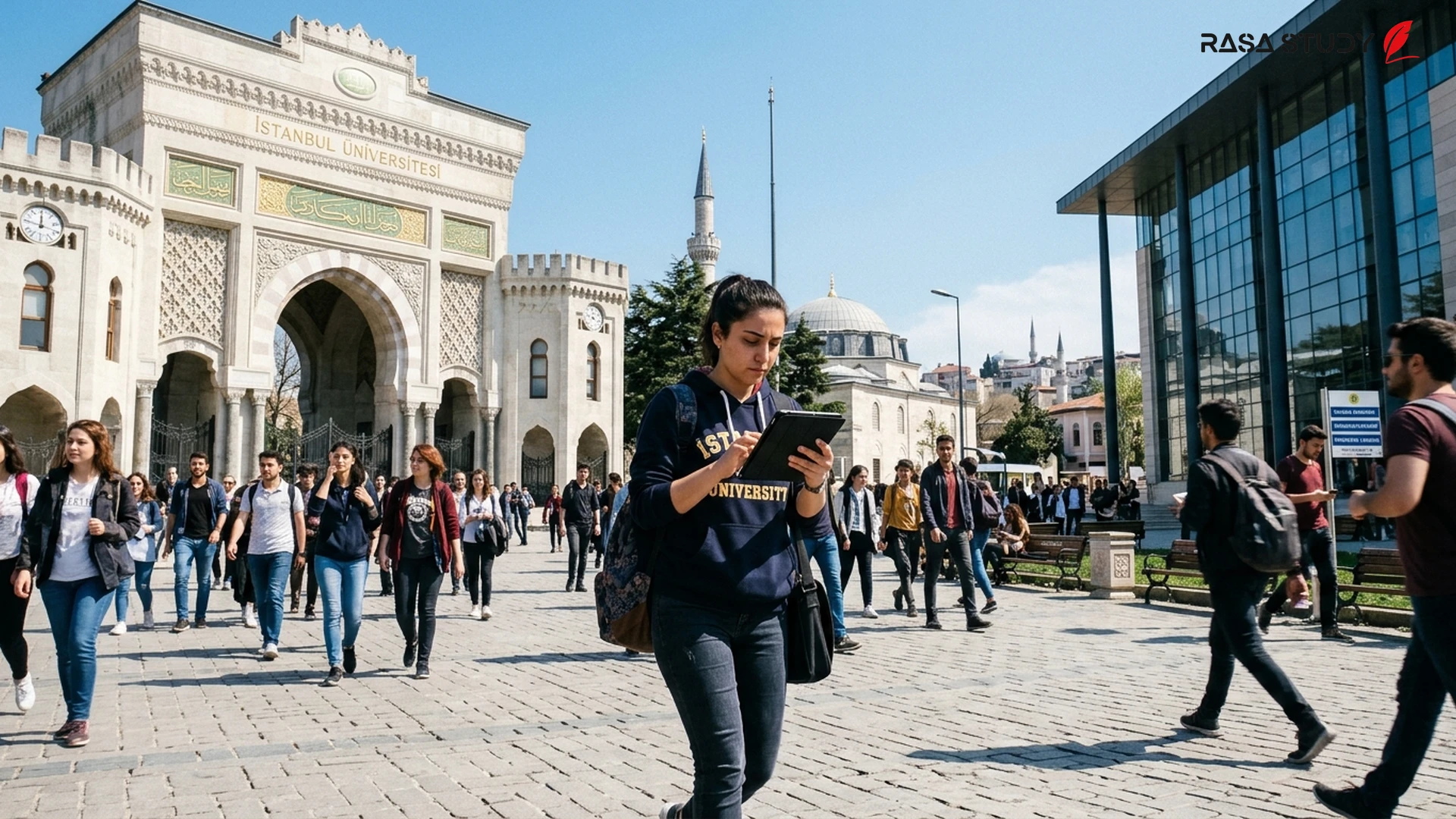
Studying at top universities in Turkey with modern facilities and global standards