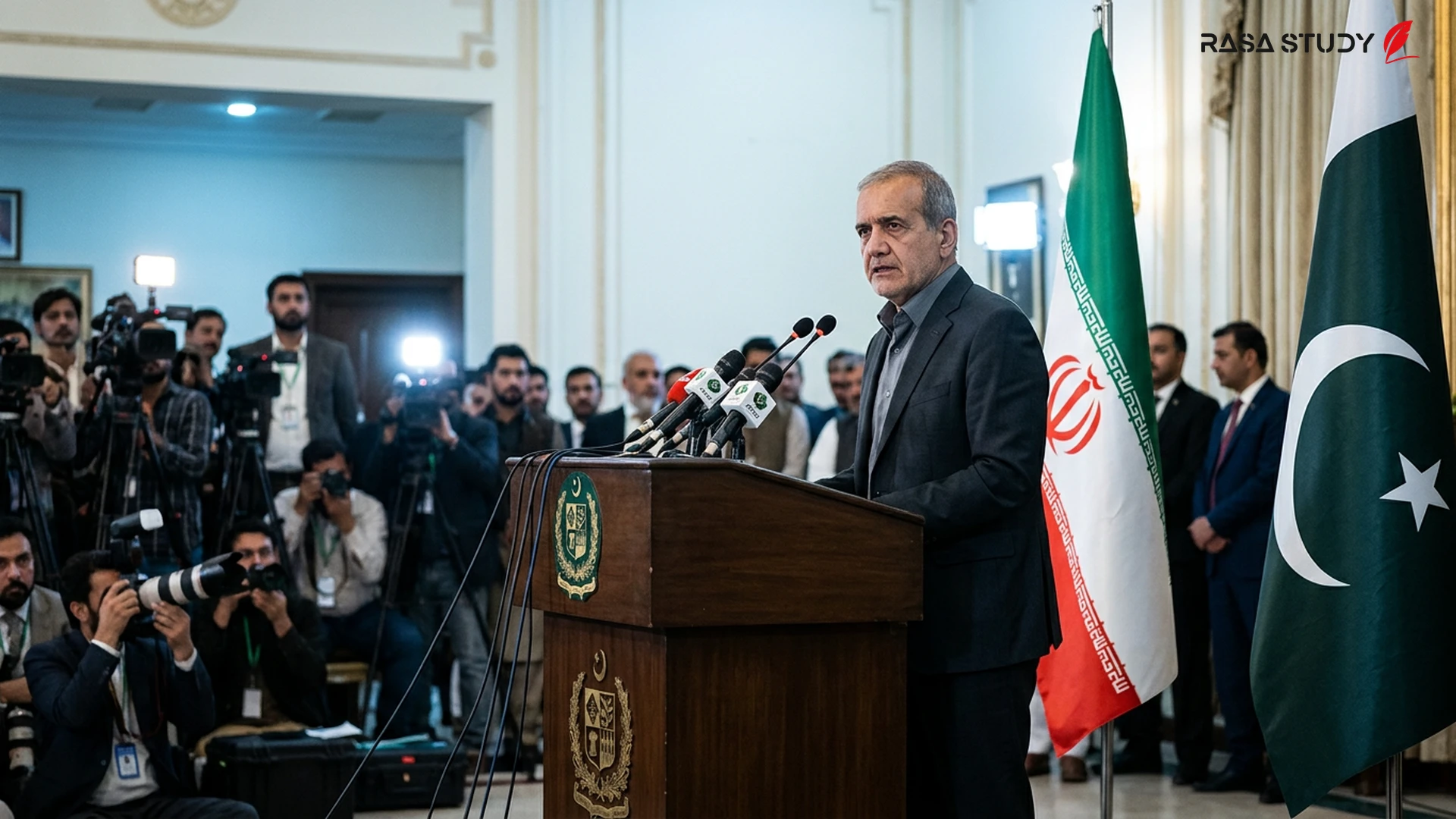
Masoud Pezeshkian, the President of Iran, during his official visit to Pakistan, firmly rejected any negotiations over the country's ballistic missile program, calling it the primary pillar of defensive deterrence against foreign threats.
Visit to Islamabad and Pezeshkian's Decisive Statement On June 23, 2026, Iranian President Masoud Pezeshkian ended all speculation regarding the possibility of Iran retreating from its missile program during an official visit to Islamabad. In a joint press conference with Pakistani Prime Minister Shehbaz Sharif, he emphasized that Iran's defensive capabilities, particularly ballistic missiles, have never been and will never be part of recent memorandums of understanding with the United States [1][4]. These remarks come as regional media outlets like "Türkiye Gazetesi" described these words as the final point of months of diplomatic discussion [1].
Missiles: A Tool for Survival Against Threats In shocking remarks, Pezeshkian compared the importance of the missile program to the critical situation in the region. He stated: "If it were not for our defensive missiles, the enemies would have leveled Iran just as they destroyed Gaza" [3]. Pointing out that Iran does not trust the United States, he stressed that missile power is the only guarantee to prevent the recurrence of human tragedies on Iranian soil [2]. The Iranian President clarified that these weapons are purely defensive and are tools for maintaining peace and national security.
The Islamabad MoU and the Absence of the Missile Issue One of the key points of this meeting was the official confirmation of the absence of missile clauses in the "Islamabad Memorandum of Understanding" (MoU) recently signed between Iran and the US through third-party mediation. Pakistani Prime Minister Shehbaz Sharif also supported Iran's position, declaring that at no stage of the indirect negotiations was the issue of ballistic missiles on the table [4]. This diplomatic clarification indicates the failure of Western efforts to include arms restrictions in the new agreements [2].
International Reactions and the Role of Mediation Pezeshkian's decisive statements have had a wide reflection in global media. While US President Donald Trump has adopted a softer tone toward the military capabilities of other countries in recent days, Iranian officials continue to insist on their lack of trust in Washington [3]. Pakistan, as a key mediator in this process, has played an important role in facilitating talks, but Pezeshkian emphasized that no mediation can force Iran to trade its national security [4]. This positioning shows that in its new era of diplomacy, Iran has drawn a precise line between "dialogue for peace" and "maintaining deterrent power."
Iranian President Masoud Pezeshkian alongside Pakistani Prime Minister Shehbaz Sharif, explaining Iran's defensive positions.
linkSources
- İran balistik füzelerden vazgeçecek mi? Pezeşkiyan tartışmalara noktayı koydu — Türkiye Gazetesi (2026-06-23)
- Pezeşkiyan: İran füzeleri mutabakat zaptında yer almadı ve almayacak — TRT Haber (2026-06-23)
- Iran's President Masoud Pezeshkian says without missiles his country would be 'just like Gaza' — Al Arabiya (2026-06-23)
- Iran's Pezeshkian asserts ballistic missiles not part of Islamabad MoU — Dawn (2026-06-23)