On July 8, 2026, Turkey has established itself as a pivotal player in the new Middle East order by hosting the NATO summit and managing complex relations with the new Syrian government and the Islamic Republic of Iran.
Today, July 8, 2026, the Middle East (West Asia) region witnesses the conclusion of the decisive NATO summit in Ankara at a time when Turkish foreign policy under the leadership of Recep Tayyip Erdogan has reached its most complex point. Recent analyses from media outlets such as Hurseda Haber indicate that Ankara is attempting to strike a strategic balance between international pressures and its regional interests regarding Iran, Syria, and Israel [1].
New Syria: Turkey's Strategic Protectorate One of the most prominent changes in the region's political map is the consolidation of the new Syrian government led by Ahmad al-Sharaa in Damascus. Turkey is now recognized as the primary economic and military supporter of this regime. During the NATO summit, al-Sharaa met with senior officials in Ankara to emphasize the deepening of bilateral relations [2]. By signing reconstruction and energy agreements, Turkey has effectively turned Syria into its strategic depth, bringing its exports to this country to unprecedented levels [3]. This shift in status has posed a serious challenge to Iran's traditional influence in Syria, making Ankara the primary actor in northern and central Syria.
Mediation between Iran and the United States While military tensions between Iran and Israel reached their peak in recent months (known as the 2026 Iran War), Turkey played an active mediating role. By maintaining open channels with Tehran and Washington, Ankara helped facilitate de-escalation agreements [1]. However, strategic competition between Iran and Turkey in Iraq and the energy sectors remains. Iranian military officials recently warned that they would respond decisively to any threat against their borders, a message indirectly aimed at the increasing presence of NATO and Turkey near their frontiers [1].
Open Confrontation with Israel Relations between Turkey and Israel in July 2026 have reached their lowest historical level. Hakan Fidan, the Turkish Foreign Minister, described Israel as a "burden on humanity" in harsh remarks and called for international sanctions against Tel Aviv [4]. Meanwhile, Israel views Turkey as an emerging threat and a strategic rival in the Eastern Mediterranean and Syria [2]. Despite Turkey's membership in NATO, the verbal and diplomatic confrontation between Ankara and Tel Aviv indicates a deep rift that even Washington's mediation has been unable to repair.
Conclusion: The Balance of Power Doctrine Turkey's current policy reflects its desire to become an independent regional power that follows its own diplomatic paths while simultaneously utilizing NATO privileges. Ankara has proven that in the new order of 2026, it is not a spectator but the main architect of developments from Damascus to Tehran [2].
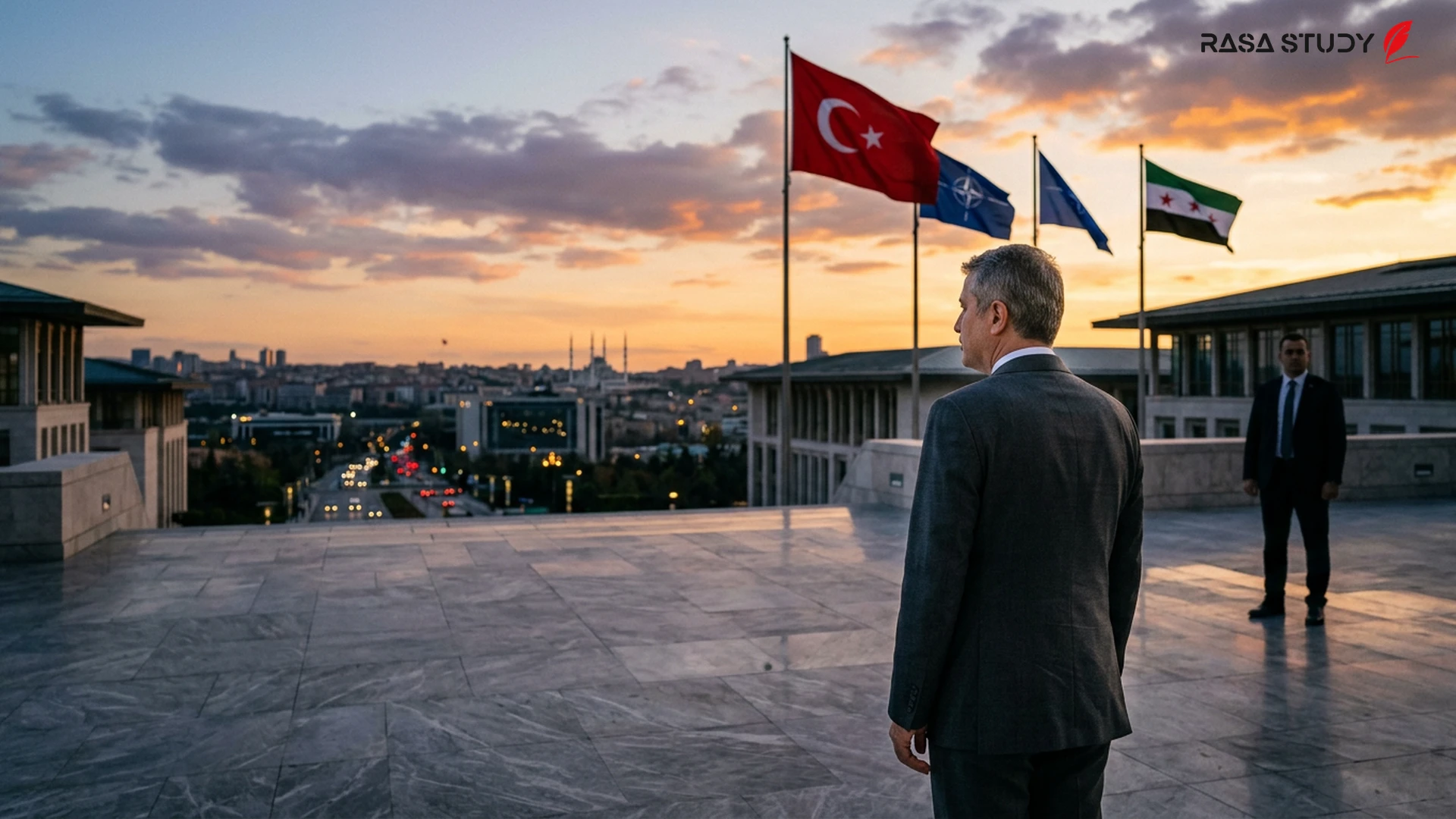
Recep Tayyip Erdogan explaining Turkey's new regional doctrine on the sidelines of the NATO 2026 summit in Ankara.
linkSources
- İran, Suriye ve İsrail bağlamında Türkiye’nin politikası — Hürseda Haber (2026-07-08)
- Turkey: The strategic challenge of tomorrow — The Jerusalem Post (2026-07-08)
- Turkey's New Role as the Key Backer of the Syrian Regime — Middle East Forum (2026-07-06)
- Turkish FM Fidan calls Israel a 'burden' on humanity — i24NEWS (2026-07-02)