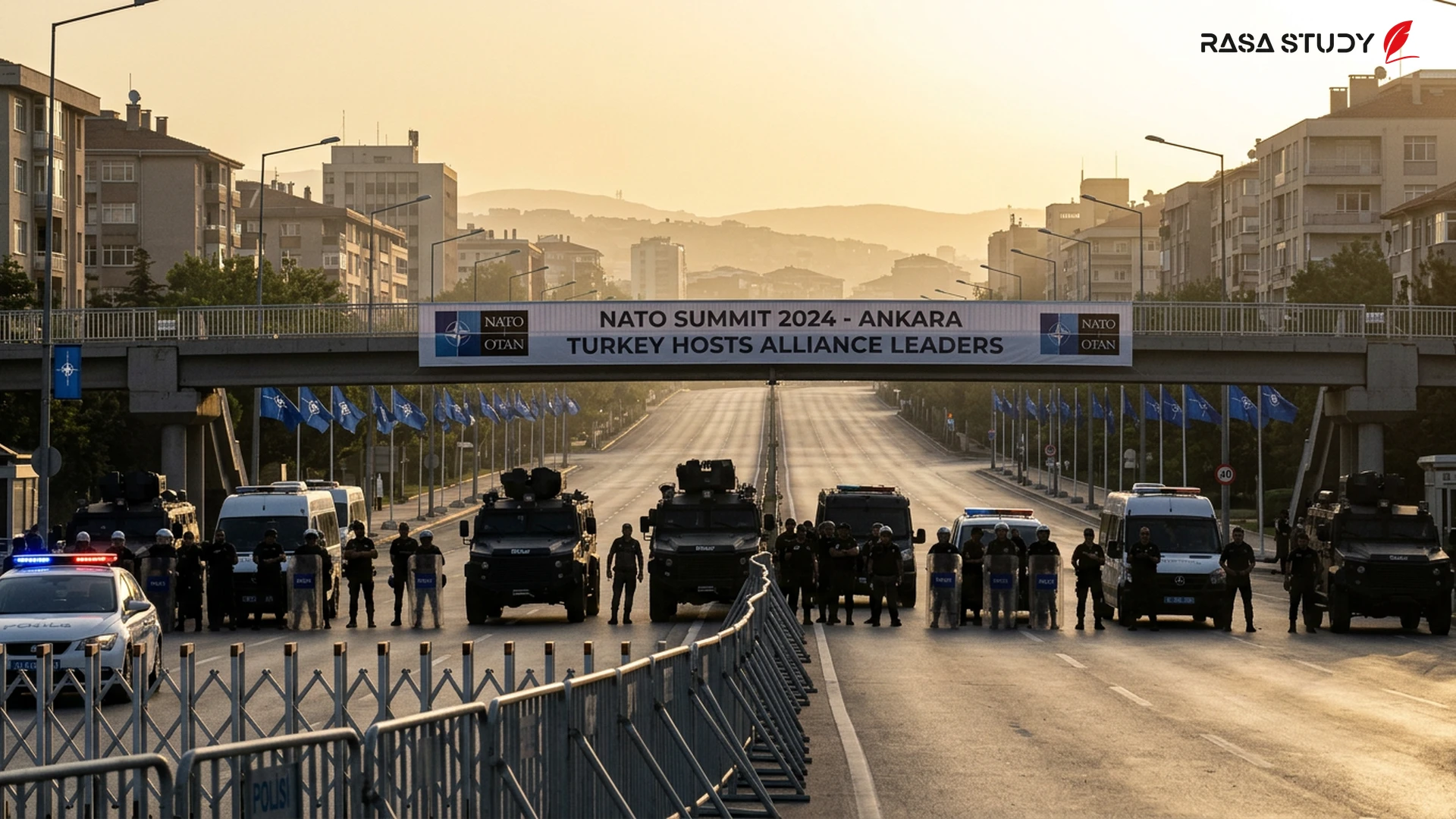
As Ankara prepares to host NATO leaders in July 2026, a new wave of activist arrests and restrictions on critical media has met with sharp reactions, with critics describing the government's official stance as "performative."
In the run-up to the NATO summit in Ankara, scheduled for July 7 and 8, 2026, Turkey's political atmosphere has become highly volatile. Domestic media outlets, including "Haber61," have published reports calling the government's official stance in support of democratic values "performative," pointing to the contradiction between diplomatic slogans and domestic repressive actions [2]. These criticisms intensified after Turkish security forces, in a large-scale operation, detained more than 200 people, including civil activists, university professors, and journalists, on charges of planning anti-government protests [2].
Media Crackdown and Unprecedented Restrictions One of the main points of criticism is the exclusion of critical media from covering the NATO summit. Reports indicate that the Turkish Presidency has refused to accredit journalists from reputable outlets such as "Cumhuriyet," "Sözcü," and "T24" [2]. Namık Tan, a former Turkish ambassador, called these actions unprecedented in the history of the NATO alliance, emphasizing that the imposition of informal curfews and the closure of local businesses in Ankara have projected a police-state image of the country that contradicts NATO's fundamental principles [2].
Dual Diplomacy; From Gaza to Brussels While Recep Tayyip Erdoğan strongly attacks Israel's policies in Gaza on international platforms and addresses Benjamin Netanyahu with harsh titles [3], domestic critics believe these positions are largely for internal consumption. They point to the continuation of underlying economic relations and the mismatch between the government's behavior regarding individual freedoms and its human rights claims. Furthermore, the recent visit of high-ranking European Union officials to Ankara on July 1, 2026, has sparked anger among human rights groups, as Brussels appears to be turning a blind eye to violations of the rule of law due to its need for Turkish cooperation in the areas of energy and migration [1].
NATO Summit; A Test for Ankara's Legitimacy The Turkish government claims that these strict security measures are necessary to ensure the safety of the leaders of the 32 NATO member states [2]. However, analysts believe that using judicial tools against political opponents on the eve of a major international event will only lead to Turkey's further democratic isolation. While Kaja Kallas, the EU's foreign policy chief, has called Turkey a "key partner," sharp reactions on social media show that public opinion views this partnership as being at the cost of ignoring domestic crackdowns [1].
Strict security measures and the arrest of activists in Ankara have sparked widespread criticism ahead of the 2026 NATO summit.
linkSources
- A high-level European Union visit to Ankara ahead of next week's NATO summit — Turkish Minute (2026-07-01)
- Turkey has arrested more than 200 people ahead of NATO summit — Kyiv Post (2026-06-30)
- Turkey's Erdogan, Israel's Netanyahu trade genocide barbs — Al Arabiya (2026-06-11)
- July Will Be a Critical Threshold in Türkiye–EU relations — Yetkin Report (2026-05-05)