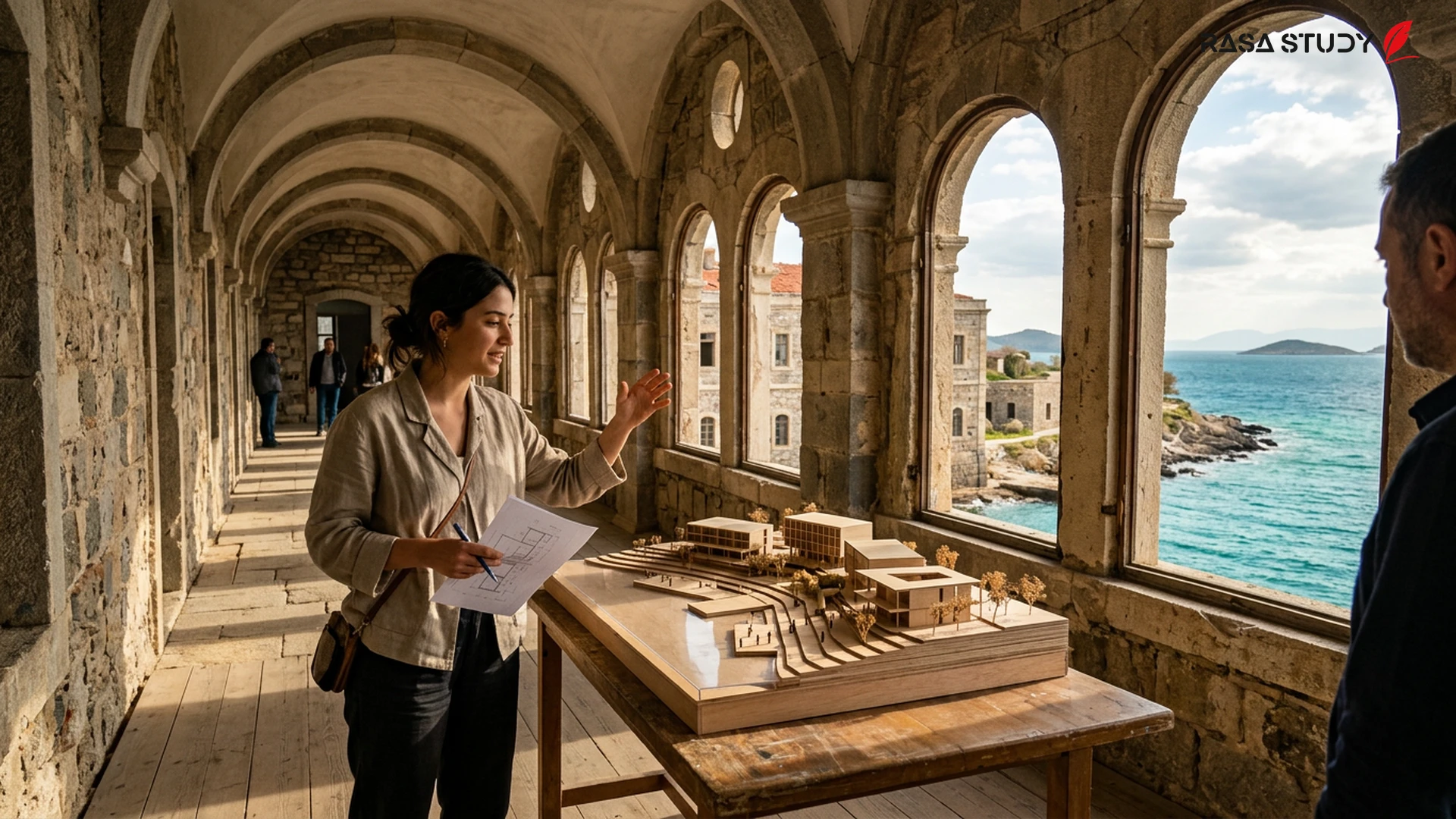
In an arts and architecture event in July 2026, interior design students from Yaşar University brought the collective and historical memory of Urla Quarantine Island in Izmir to life in a modern way by presenting projects titled "Beyond the Lock."
An Ottoman Legacy in the Heart of Izmir Urla Quarantine Island (Urla Karantina Adası), located in Turkey's Izmir province, is one of the few remaining quarantine centers in the world dating back to the Ottoman era. Built in 1865 by French engineers, the island served for decades as a barrier against infectious diseases such as cholera and plague [3]. Today, this site is not only an architectural monument but also a symbol of health history and humanity's struggle against epidemics. In July 2026, this historical space hosted a fresh perspective from a young generation of architects to brush the dust of oblivion off its face.
Projects Breaking the Silence of History Senior students from Yaşar University's Department of Interior Architecture and Environmental Design, under the supervision of professors such as Sergio Taddonio and Ebru Karabağ, designed projects aimed at conveying the human experiences of the past to today's visitors [1]. The exhibition, titled "Beyond the Lock: Shaping Transience, Embodying Absence," focused on concepts such as isolation, waiting, and hope. Using models, technical drawings, and digital presentations, students designed scenarios where visitors can understand the feelings of travelers confined to this island centuries ago [2].
Sensory Experience of Isolation and Hope in Student Designs Among the works presented, some projects caught the jury's attention due to their deep sensory perspective. The project "Tidal Ribs" (Gelgit Kaburgaları) by Eda Tulunay and Sude Naz Aydın designed a symbolic path that reconstructs the movement of passengers through the quarantine process [1]. Additionally, the project "Pieces of Isolation" (İzolasyonun Parçaları) attempts to convey the psychological atmosphere of the quarantine era to the audience by utilizing light, shadow, and even specific scents [2]. These designs show that architecture is not just about building space, but a tool for narrating the unwritten stories of history.
Architecture as a Bridge Between Past and Future A significant point in all these designs is the respect for the historical and untouched fabric of the "Tahaffuzhane" (Quarantine House) building. Students proposed their modern interventions with great care and without damaging the main structure of the building [1]. This approach demonstrates the intellectual maturity of young designers in dealing with cultural heritage. With the island becoming a health museum in 2026, these student projects could serve as a model for enriching the visitor experience and linking the new generation with the historical roots of the Urla region [3].
Exhibition of Yaşar University student projects at the historical Tahaffuzhane building, July 2026
linkSources
- Karantina Adası’nın hafızası öğrenci tasarımlarıyla canlandı — Yeni Asır (2026-07-18)
- Karantina Adası’nın hafızası öğrenci tasarımlarıyla canlandı - İzmir Haberleri — Habertürk (2026-07-17)
- Zamanın Durduğu Yer: Urla Karantina Adası Kapılarını Aralıyor — Akşam Haberleri (2026-03-30)