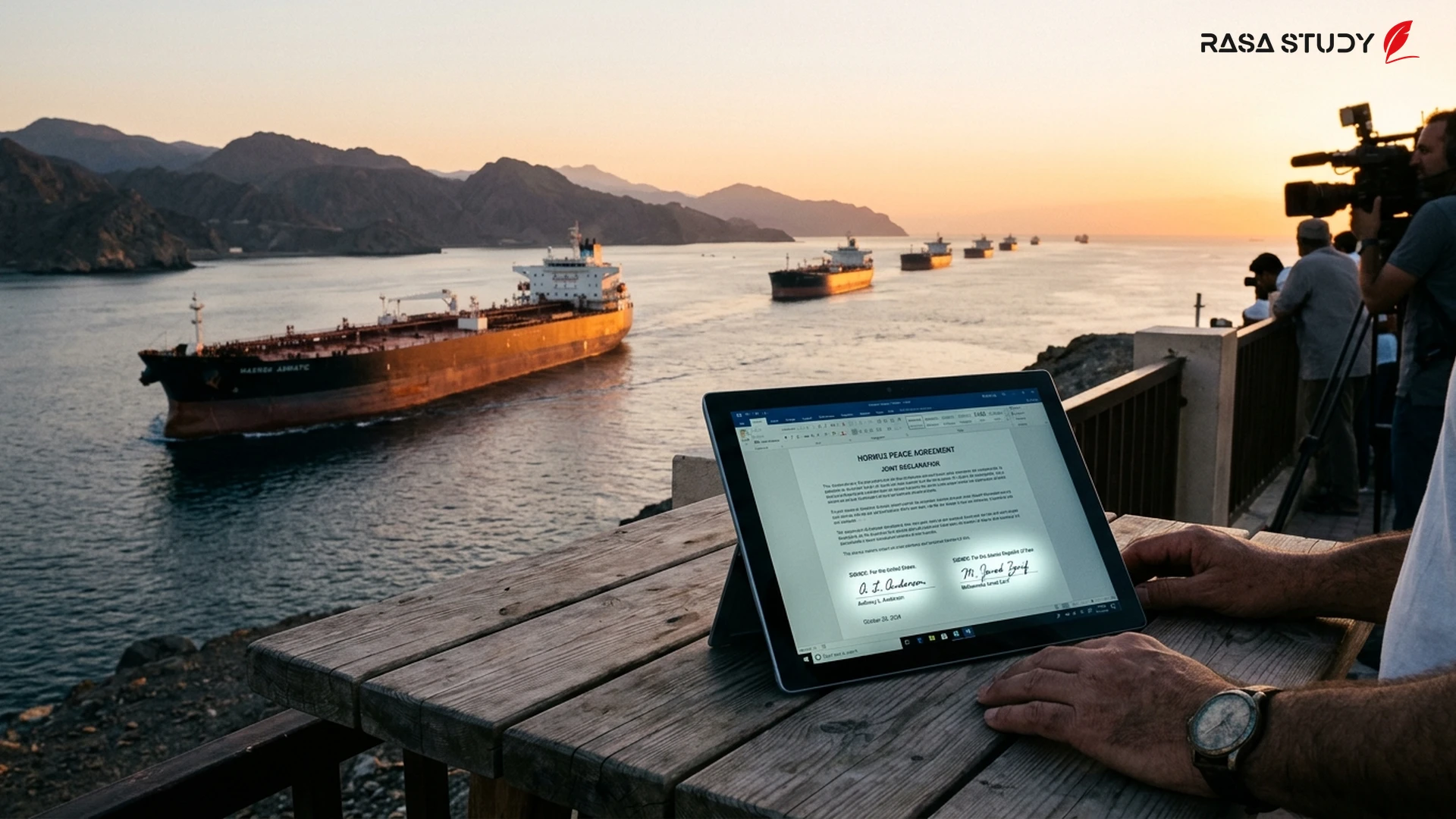
US Vice President JD Vance announced that Washington and Tehran have digitally signed a Memorandum of Understanding (MoU) to end a three-month conflict, with a formal signing ceremony scheduled for Friday in Switzerland.
Digital Signature; A Step Toward Ending Tensions In a dramatic development in global diplomacy, US Vice President JD Vance confirmed that a preliminary agreement between Washington and Tehran to end recent hostilities has been signed digitally. Speaking to international media, Vance stated that this Memorandum of Understanding (MoU) was electronically signed on Sunday, June 14, 2026, by Donald Trump, himself, and Mohammad Bagher Ghalibaf, the Speaker of the Iranian Parliament [1][2]. This move is seen as a prelude to the official signing ceremony set to take place this Friday in Geneva, Switzerland.
Agreement Details: Reopening Hormuz and Return of Inspectors According to Vance, the agreement, reached after a tense three-month war, includes key provisions for stabilizing energy markets. The most significant clause of this memorandum is the immediate and toll-free reopening of the Strait of Hormuz, which had become a flashpoint of conflict in recent months [3]. Additionally, an agreement has been reached on a 60-day ceasefire and the return of International Atomic Energy Agency (IAEA) inspectors to Iranian nuclear facilities. Vance emphasized that the United States and the Agency will cooperate in destroying Iran's enriched uranium stockpiles to ensure Tehran never attains a nuclear weapon [4].
Sanctions Removal; Conditional on Tehran's Full Compliance Responding to questions regarding the release of Iran's frozen assets, the US Vice President explicitly stated that no funds have been released to date. He stressed that the lifting of sanctions and Iran's access to a $300 billion reconstruction fund (financed by Gulf Cooperation Council countries) will be entirely "performance-based" [1][3]. In other words, economic openings will only begin if Iran fulfills its commitments regarding nuclear verification and the cessation of military activities. Vance also dismissed rumors regarding the immediate release of $24 billion of Iranian assets, stating it is subject to later stages of technical negotiations [4].
International Reactions and the Role of Regional Media The news has been widely reflected in Turkish media, including the newspaper "Akdeniz Manşet," as stability in the Middle East directly impacts the economy and security of the Mediterranean region [1]. World leaders, including the President of the European Council, have welcomed the agreement, calling it an end to a "costly war." However, Vance noted that while great progress has been made, achieving lasting peace will take time, and technical negotiations to finalize complex details will continue in the coming weeks [2][3].
US Vice President JD Vance outlines the details of the digital agreement with Iran in June 2026.
linkSources
- Vance: Anlaşmayı dün dijital olarak imzaladık — Akdeniz Manşet Gazetesi (2026-06-15)
- Trump, Vance sign Iran-US memorandum with Ghalibaf, official says — Daily Sabah (2026-06-15)
- Iran 'agreed to never have a nuclear weapon', says Trump – as it happened — The Guardian (2026-06-16)
- Will Iran get access to frozen assets after deal signing on June 19? — Hindustan Times (2026-06-15)


