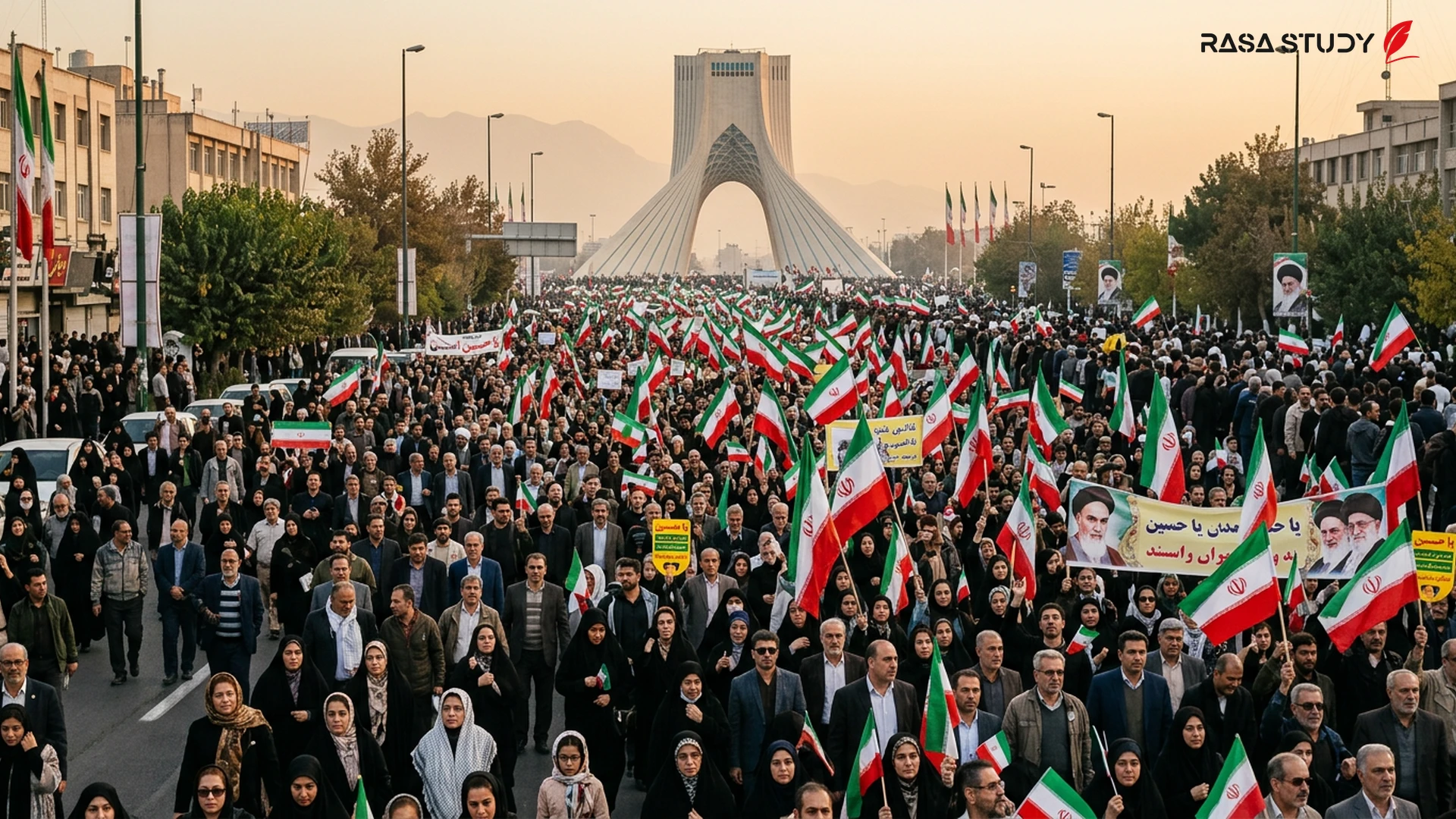
Foad Izadi, a professor at the University of Tehran, in an exclusive interview with the Turkish media outlet "Odatv," dissected the million-strong turnout in recent ceremonies and revealed the reasons behind Western media's failure to grasp the realities of Iranian society.
Following recent developments and the unprecedented presence of people in the streets of Tehran, Dr. Foad Izadi, Head of American Studies at the Faculty of World Studies, University of Tehran, explained new dimensions of Iran's political and social situation in a detailed interview with "Odatv." Izadi, known as a strategist close to the establishment, believes that the West has once again made a miscalculation in analyzing the behavior of the Iranian masses [1].
The Secret of the Million-Strong Presence in the Streets Responding to the Odatv reporter's question about the cause of the massive turnout in recent ceremonies, Izadi pointed to a phenomenon he called the "rally 'round the flag effect." He explained that external pressures and military threats, instead of weakening national cohesion, have led to greater unity among various segments of the people. He emphasized that the culture of resistance has historical roots in Iran, and when people feel their country's independence is at risk, they set aside internal differences and take to the streets [2]. He also noted that Western media, by focusing solely on economic problems, are unable to understand the emotional and ideological bond of a large part of society with the values of the revolution [1].
Exposing Western Media Tactics A significant part of Izadi's remarks was dedicated to criticizing the performance of international media. He claimed that during the economic protests in January, Western media tried to divert public attention from crimes in Gaza by exaggerating casualty figures and bringing them to imaginary numbers (such as 30,000 people) [1]. Presenting official statistics, Izadi emphasized that crisis management in Iran was carried out with restraint, and much of the violence was directed by infiltrators linked to foreign intelligence services to paint a violent image of the system [2].
Political Stability and the Succession Issue While some Western analysts speak of a power vacuum in Tehran, Izadi described these claims as "daydreaming." Pointing to the legal mechanisms in the Iranian Constitution, including the role of the Assembly of Experts, he emphasized that the power structure in Iran does not rely on an individual and the process of power transition proceeds in a completely institutionalized manner [2]. He also referred to the personal lives of Iran's leaders, stating that the distance of the Leader's children from positions of power and economic rents is one of the reasons for the people's trust in the health of the political structure [1].
The Strait of Hormuz: A New Strategic Tool At the end of this conversation, Izadi referred to Iran's defensive and geopolitical capabilities, saying that Iran now possesses new pressure tools that it did not use so explicitly before. He identified the "Strait of Hormuz" as one of these tools and warned that any military adventure by the Trump administration or its allies would be met with a regrettable reaction that would affect global energy security [1][3].
Dr. Foad Izadi, senior analyst, dissected the popular presence in Iran in a conversation with Odatv.
linkSources
- Tahran’ın beyinlerinden Fuat İzadi Odatv’ye anlattı: İran'daki kalabalığın sırrı — Odatv (2026-07-09)
- Iran Will 'Push Back', Says Tehran Professor, Rejects Notion of Leadership Vacuum After Strikes — NDTV (2026-03-02)
- Massive Crowds Gather In Tehran For Ayatollah Khamenei's Funeral — India Today (2026-07-07)