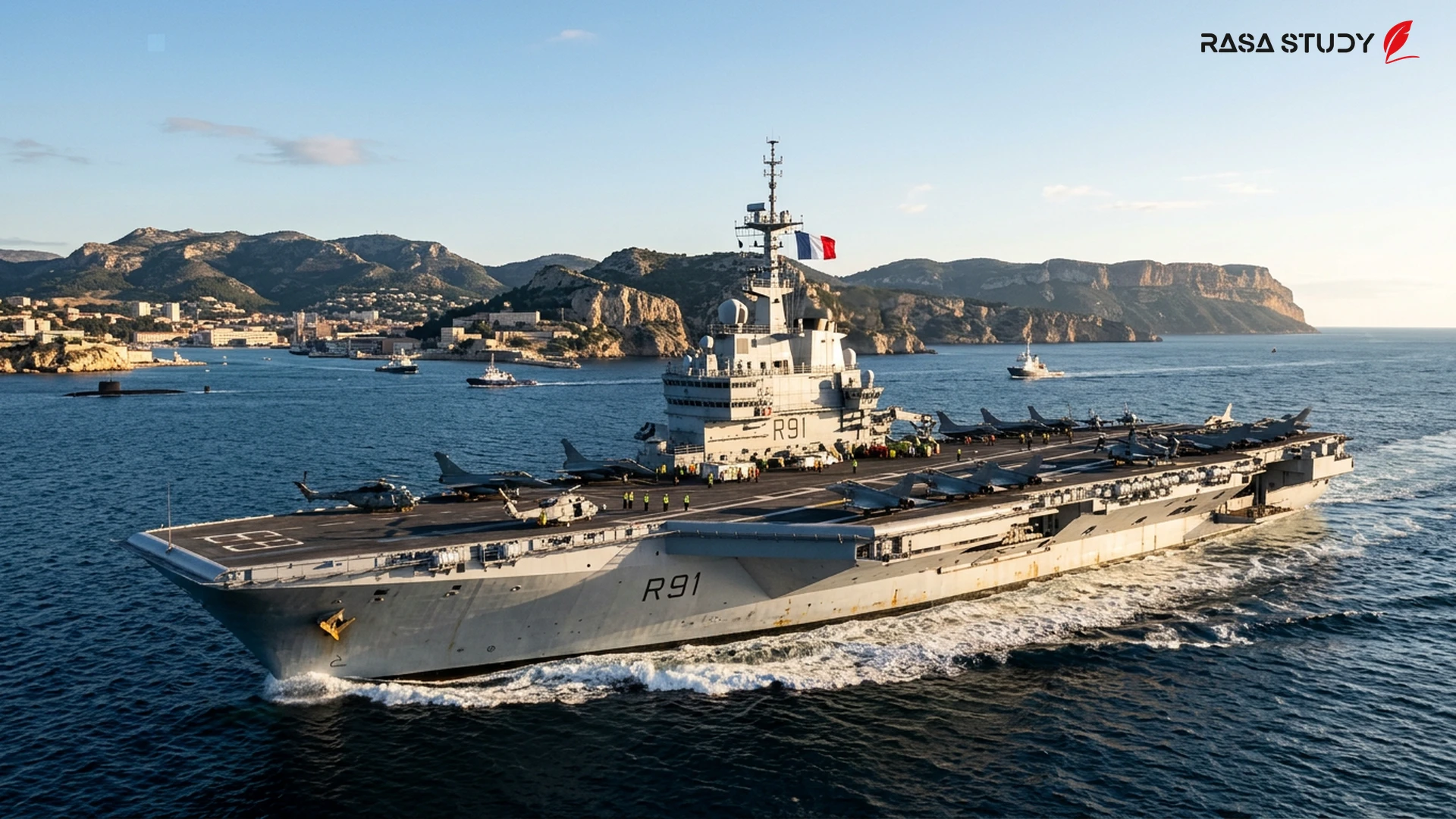
French President Emmanuel Macron has ordered the return of the aircraft carrier "Charles de Gaulle" to the port of Toulon. This decision follows recent diplomatic progress and the signing of a memorandum of understanding between Washington and Tehran.
The French Navy officially announced that the aircraft carrier Charles de Gaulle, the symbol of the country's naval power, has set a course for its home port in Toulon after completing its surveillance and security mission in the sensitive Persian Gulf and Strait of Hormuz region [1]. This decision, announced by Emmanuel Macron on social media, indicates a shift in France's military posture in the Middle East.
Details of the Charles de Gaulle's Return to France The aircraft carrier Charles de Gaulle, which had been deployed near the Arabian Peninsula since mid-May 2026, now sees its mission concluded. Macron stated in a statement that given the "positive developments" in international negotiations, there is no longer a need for the carrier's presence in the region [2]. During its deployment, this strike group was responsible for protecting freedom of navigation and monitoring trade routes. Reports indicate that the Charles de Gaulle is currently in the Mediterranean Sea and will soon dock at the port of Toulon [3].
Impact of the Iran-US Agreement on Paris's Decision The primary reason for this strategic withdrawal is cited as the signing of a memorandum of understanding on June 17, 2026, between the United States and Iran, which led to a significant reduction in regional tensions [4]. Macron described this agreement as an important step for regional stability and stated that France always adjusts its military presence based on current security needs. The reduced likelihood of direct conflict in the Strait of Hormuz convinced Paris to end the deployment of its heaviest naval unit in the region [1].
Continued Limited French Presence for Maritime Security Despite the return of the aircraft carrier, France is not fully withdrawing from the region. Macron emphasized that the country's mine-clearing assets and frigates will remain in the region to cooperate with international allies if necessary [2]. This equipment includes two mine-sweepers, two frigates, and one maritime patrol aircraft, which remain on standby to ensure the safety of commercial ship traffic in the Strait of Hormuz [5].
Strategic Importance of the Strait of Hormuz for the Global Economy The Strait of Hormuz is recognized as one of the world's most vital economic arteries, through which approximately 20% of the world's crude oil and 25% of liquefied natural gas (LNG) exports pass [4]. France and the United Kingdom emphasized in a joint statement that restoring full security to this maritime route is a matter of global importance. France's cooperation with Oman will also continue in this regard to ensure the security of the country's territorial waters for international navigation [3].
The aircraft carrier Charles de Gaulle returns to the port of Toulon after ending its mission in the Strait of Hormuz.
linkSources
- Macron orders the return of the Charles de Gaulle after the advance of negotiations between the US and Iran — Demócrata (2026-07-03)
- Aircraft carrier Charles de Gaulle returns to France from Middle East — Anadolu Agency (2026-07-04)
- French aircraft carrier set to head home after Hormuz deployment — The National (2026-07-04)
- France deploys naval forces to support security in Strait of Hormuz — AzerNews (2026-07-04)
- UK and France Prepare Maritime Mission to Secure Strait of Hormuz — Kurdistan24 (2026-07-05)


