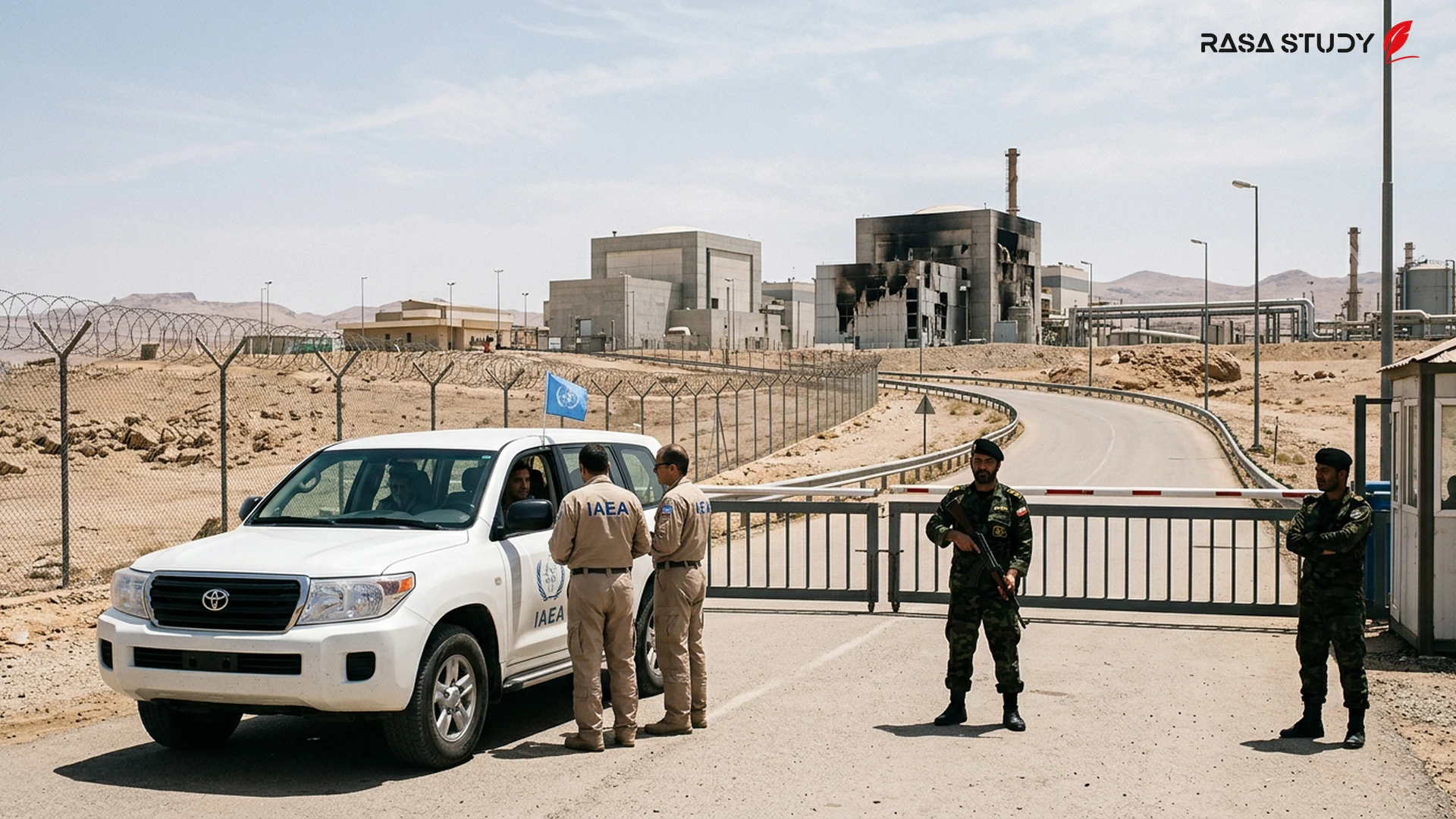
Following increased speculation about a new nuclear deal, high-ranking Iranian officials have categorically denied any plan or agreement with the International Atomic Energy Agency (IAEA) to inspect facilities damaged in military attacks.
Tehran Rejects IAEA and Washington Claims Following reports of Iran's agreement to new inspections, Esmaeil Baghaei, the spokesperson for the Iranian Ministry of Foreign Affairs, explicitly stated in a recent press conference that there are no plans for International Atomic Energy Agency (IAEA) inspectors to access nuclear facilities damaged during recent conflicts [1][2]. These remarks were made in response to statements by U.S. Vice President J.D. Vance, who claimed that Iran had agreed to the return of inspectors to these sites.
Kazem Gharibabadi, Iran's Deputy Foreign Minister, also released a message on social media denying any meeting with Rafael Grossi, the Director General of the IAEA, on the sidelines of the Swiss meetings [1]. He emphasized that access to damaged sites and the nuclear materials within them is not on the current agenda, and Tehran will not allow imposed policies to proceed through "media hype" [3].
Conflicting Narratives; A War of Words Between Iran and the IAEA While Tehran emphasizes the absence of any protocol for inspecting targeted centers, Rafael Grossi announced in Tokyo that inspections "will certainly take place" according to the recent memorandum of understanding [4]. Describing the situation as a "war of words," Grossi noted that the exact timing of these inspections is not vital, but the principle of monitoring Iran's nuclear activities is an inseparable part of the agreements [4].
This disagreement emerges as U.S. President Donald Trump also claimed to have precise information regarding Iran's agreement to these inspections. However, Iranian officials believe that inspecting sites such as Natanz and Fordow, which were damaged in attacks last year, will only be considered within the framework of a "final agreement" and after the complete lifting of sanctions [1][3].
Current Monitoring Status and Iran's Conditions According to the Foreign Ministry spokesperson, Iran remains committed to its obligations under the Treaty on the Non-Proliferation of Nuclear Weapons (NPT), and routine inspections of undamaged facilities, such as the Bushehr power plant, continue as usual [2][3]. However, access to sensitive centers targeted in military attacks is considered a "red line" and is contingent upon the results of the 60-day negotiations in Switzerland.
Iran emphasizes that any practical step by Tehran must be accompanied by a reciprocal action from Washington in lifting oil and banking sanctions. Until then, access for inspectors to the ruins of enrichment facilities, which are said to hold significant amounts of 60% enriched uranium, will not be possible [4]. This diplomatic deadlock indicates the difficult path ahead to transform the temporary memorandum into a lasting agreement.
Tehran rejected any agreement to inspect sites damaged in military attacks.
linkSources
- İran’dan UAEA’ya yalanlama: Vurulan tesisler için denetim planı yok — Cumhuriyet (2026-06-24)
- بقائی بازرسی آژانس از تاسیسات هستهای بمبارانشده را تکذیب کرد — Defapress (2026-06-23)
- Iran says IAEA inspections of damaged nuclear sites are not planned — The Times of Israel (2026-06-23)
- IAEA chief says nuclear inspection of Iranian sites will happen — CBS News (2026-06-24)


