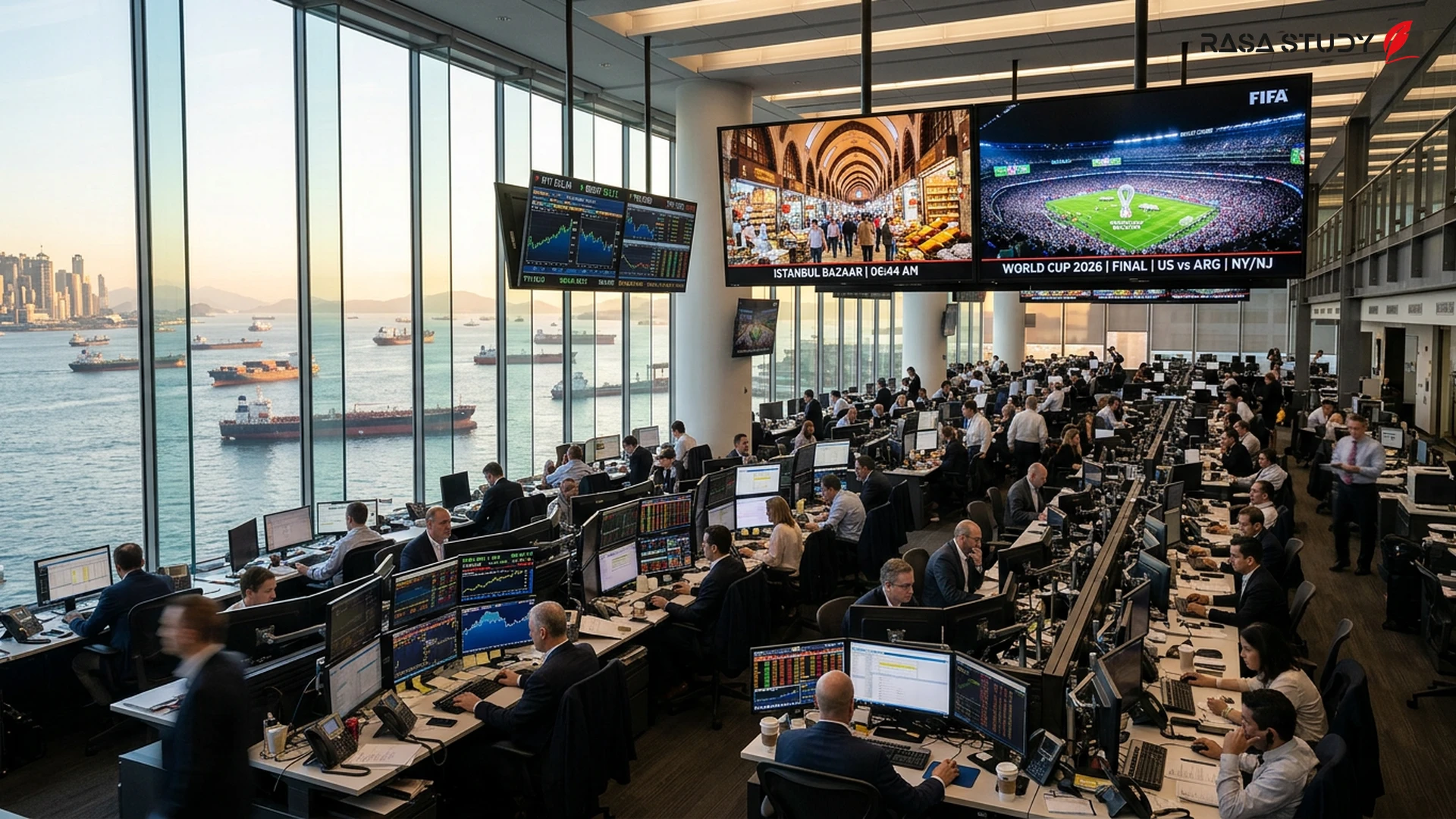
As June 2026 draws to a close, financial markets are facing three key events: the release of Turkey's inflation data, the United States employment report, and the fragile peace negotiations between Tehran and Washington following months of military tension.
Today, June 30, 2026, investors and economic analysts are focused on three sensitive points that could determine the path of financial markets in the second half of the year. Economic analyst İbrahim Ekinci emphasizes in his recent report that the convergence of macroeconomic data in Ankara and Washington with diplomatic developments in the Middle East has created an atmosphere full of both fear and hope [1].
First Focus: Turkey's Inflation Data and the Fate of Wages Within Turkey, all eyes are on the June inflation report scheduled to be released on July 3 by the Turkish Statistical Institute (TÜİK). According to recent surveys of economists, annual inflation is expected to decrease from 32.61% in May to 32.17% in June [4]. This data is not only vital for the policies of the Central Bank of the Republic of Turkey (CBRT), which has kept interest rates steady at 37%, but also directly affects the livelihoods of millions of employees and retirees, as their salary increase rates will be determined based on these statistics [1][4]. Despite tight monetary policies, inflation remains above 30%, and reaching the 24% target for the end of 2026 faces serious challenges [1.3.1].
Second Focus: The Pulse of the US Labor Market and the 2026 World Cup Impact On the external front, the US Non-Farm Payrolls (NFP) report is the center of attention. The US labor market outperformed expectations in May by creating 172,000 jobs [1.4.3]. For June, forecasts suggest the creation of approximately 145,000 new jobs [1.4.5]. A notable point in 2026 is the impact of hosting the FIFA World Cup on the US labor market; the service and hospitality sectors have seen significant hiring growth due to the influx of tourists [1.4.5]. However, speeches by Federal Reserve officials, including Kevin Warsh, indicate that the US central bank remains focused on curbing inflation, with a possibility of an interest rate hike in October 2026 [1.2.3].
Third Focus: Diplomacy on the Edge; Iran-US Negotiations Perhaps the most sensitive variable for global markets is the progress of negotiations between Iran and the United States. Following the signing of the Islamabad Memorandum on June 17, 2026, by Donald Trump and Masoud Pezeshkian, a 60-day period to reach a final agreement has begun [5]. Today, Trump claimed that an important meeting will be held in Doha, Qatar, although officials in Tehran have denied plans for direct negotiations in the coming days [3]. The return of International Atomic Energy Agency inspectors to nuclear sites and the management of the Strait of Hormuz are the main points of contention [2][5]. Despite these tensions, Brent crude oil prices have remained stable around $72, indicating the market's cautious optimism regarding the continuation of the ceasefire and energy flow [1].
The convergence of economic data and political developments on June 30, 2026, has placed global markets in a state of anticipation.
linkSources
- Üç dikkat noktası: İçerde enflasyon verisi dışarıda ABD istihdam verisi ve İran müzakereleri — Kısa Dalga (2026-06-30)
- Iran has agreed to allow UN nuclear inspectors back into the country — The Guardian (2026-06-22)
- US president says a meeting with Iran will take place in Doha today — Al Jazeera (2026-06-30)
- Economists expect Türkiye's annual inflation to ease to 32.17% in June — Yeni Şafak (2026-06-29)
- The Islamabad Memorandum of Understanding Between the United States and Iran — IISS (2026-06-26)