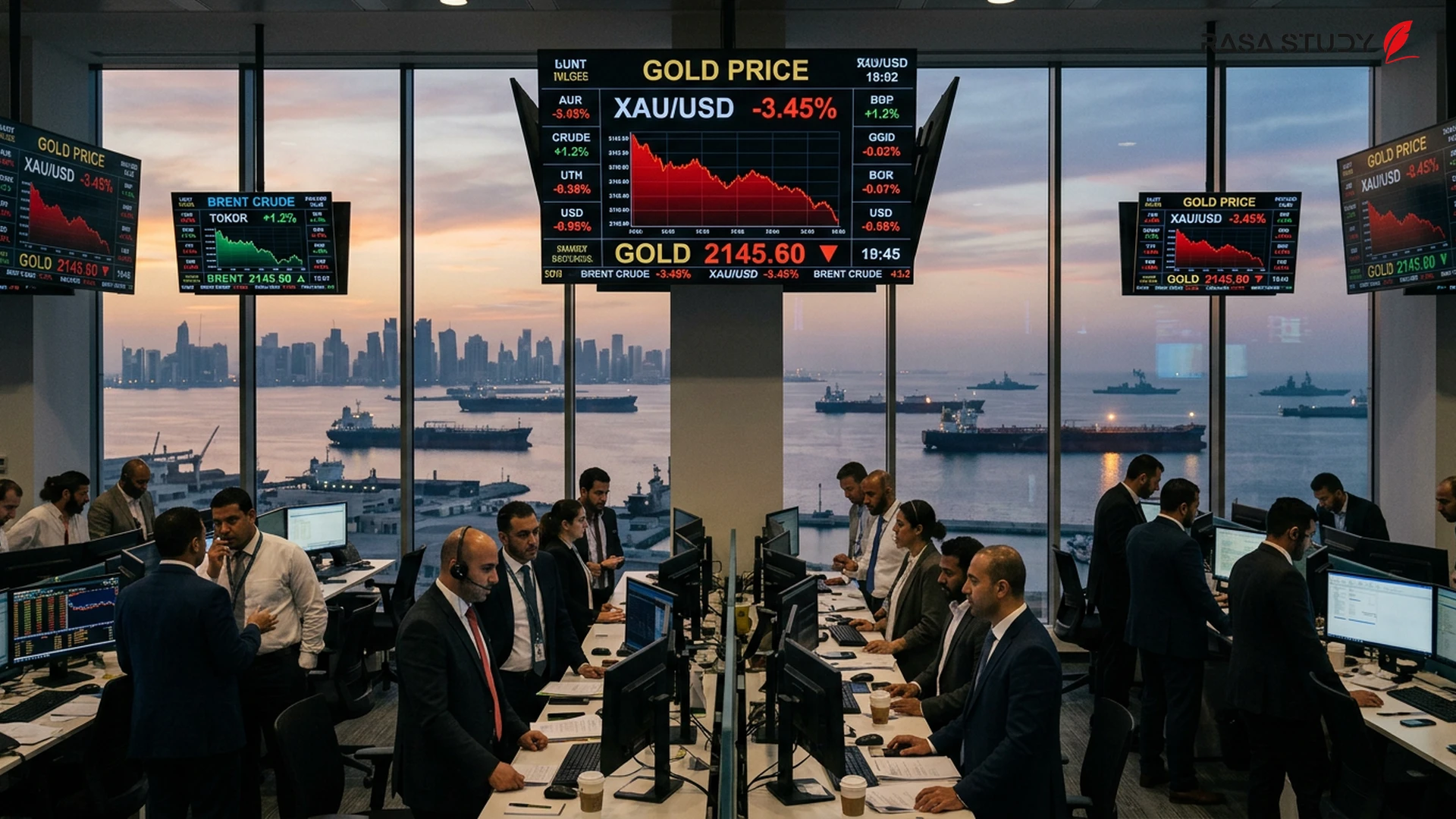
While global markets watch the Strait of Hormuz with concern, gold prices unexpectedly fell below the $4050 mark in today's trading, June 29, 2026; a phenomenon analysts attribute to interest rate pressure and a strengthening dollar.
Today, Monday, June 29, 2026, global markets witnessed a paradoxical reaction to geopolitical developments in the Middle East. While news of sporadic clashes between United States and Iranian forces in the Persian Gulf emerged, global gold prices took a downward trend, contrary to its traditional role as a "safe haven." According to published reports, the price of gold per ounce fell by approximately 1% to reach the $4032 level [1][4].
Unexpected Market Reaction to Military Crisis Late last week, exchanges of fire between Iranian drones and American bases in Kuwait and Bahrain increased fears of another closure of the Strait of Hormuz. However, instead of rising, the gold market came under pressure. The primary reason for this is the jump in oil prices to above $93 and the subsequent reigniting of inflationary concerns in the global economy [2]. Analysts believe that rising energy costs will force the US Federal Reserve to keep interest rates at high levels for a longer period. Since gold is a non-yielding asset, increased expectations for higher interest rates have reduced the metal's appeal against the dollar [3].
Islamabad Memorandum and Doha Diplomacy Another factor reducing gold's "risk premium" is conflicting diplomatic signals. Despite the weekend clashes, both sides have announced that they will resume technical negotiations tomorrow (Tuesday) in Doha, Qatar, to avoid an all-out war [3]. These negotiations, pursued within the framework of the "Islamabad Memorandum" (concluded on June 17), include clauses for the safe reopening of the Strait of Hormuz and the release of a portion of Iran's frozen assets [4]. Traders, viewing these talks with relative optimism, have moved some of their assets out of the gold market toward riskier markets.
Double Pressure from the Dollar Index and Technical Analysis Currently, gold is experiencing its fourth consecutive month of value decline, with a price correction of more than 25% from its historical peak of $5608 in January 2026 [4]. The strengthening of the US Dollar Index to its highest level in a week has made gold more expensive for holders of other currencies and suppressed physical demand in major markets like China [3]. Technically, breaking the $4050 support level could pave the way for a further drop toward the $4000 psychological boundary, unless the Doha negotiations fail and spark a new military crisis [2][5].
Outlook for the Coming Days Investors are now waiting for the release of US Non-Farm Payrolls (NFP) data later this week to gain a clearer perspective on Federal Reserve monetary policy. While Iran-US tensions continue to act as a potential catalyst, for now, the shadow of interest rates and dollar strength weighs heavier on the gold market than the drums of war [3][4].
Severe gold price fluctuations on June 29, 2026, influenced by Doha negotiations and Federal Reserve monetary policies.
linkSources
- Yeniden Alevlenen ABD-İran Gerilimi Altını Geriletti — Haber365 (2026-06-29)
- Altın ABD-İran saldırılarının etkisiyle geriledi — Bloomberg HT (2026-06-29)
- Gold weakens on US-Iran de-escalation, expectations of Fed tightening — FXStreet (2026-06-29)
- Gold - 2026 Data - 1970-2025 Historical — Trading Economics (2026-06-29)