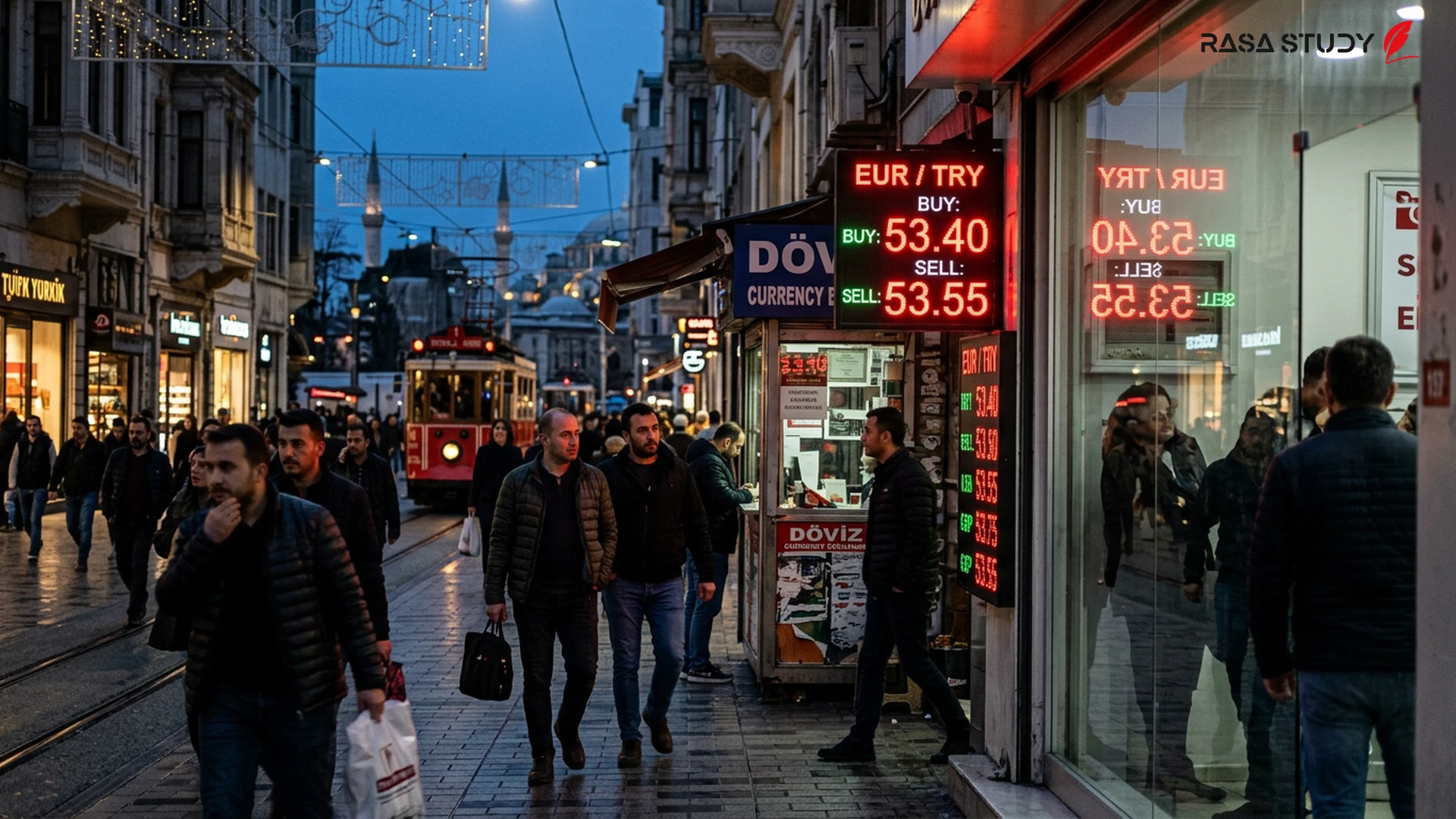
In morning trading on July 8, 2026, the Euro exchange rate against the Turkish Lira reached the 53.55 level. Despite the Central Bank's efforts to maintain stability through a 37% interest rate, geopolitical tensions continue to put pressure on the Lira's value.
Fresh Fluctuations in the Turkish Foreign Exchange Market
Today, Wednesday, July 8, 2026, the Turkish foreign exchange market witnessed a relative increase in prices. According to published reports, each Euro is trading at 53.55 Lira in the financial markets [1]. This figure indicates the continuation of a mild upward trend for the Euro against Turkey's national currency. In today's transactions, the Euro's buying price was recorded at 53.5507 Lira and its selling price at 53.5587 Lira, representing an increase of approximately 0.11% compared to yesterday [1].
In addition to the Euro, other major currencies also experienced an upward trend. The US Dollar crossed the 46.85 Lira mark, and the British Pound is trading at the 62.64 Lira level [1]. These fluctuations occur as investors closely monitor political and economic developments in the region.
Central Bank Monetary Policy and Interest Rates
The Central Bank of the Republic of Turkey (CBRT) decided in its latest meeting to keep the bank interest rate steady at 37% [2]. Fatih Karahan, the Governor of the Central Bank, emphasized in his recent meetings with investors that contractionary policies will continue until a sustainable reduction in inflation is ensured. The next Monetary Policy Committee meeting is expected to be held on July 23, 2026, and analysts predict that the interest rate will remain at the current level to prevent severe currency fluctuations [2].
The Central Bank of Turkey has also announced that it is strictly controlling market liquidity. These measures have intensified particularly following recent tensions in the Middle East and rising energy prices, which have increased Turkey's import costs [4].
Inflation and Economic Challenges Ahead
Official data shows that Turkey's annual inflation rate reached 32.11% in June 2026, showing a slight decrease compared to the 32.61% rate in May [3]. Although this downward trend is encouraging for the government, inflation remains at a level significantly higher than medium-term targets. The housing and energy sectors, with inflation exceeding 45%, are putting the most pressure on household livelihoods [3].
The World Bank noted in its recent report that Turkey's economic growth for 2026 has been adjusted to 2.8% due to regional tensions and high energy costs [4]. The report emphasizes that maintaining Lira stability in the short term requires the continuation of high real interest rates and macro-prudential measures.
Economic Outlook for the Second Half of 2026
As it enters the second half of 2026, the Turkish economy faces a combination of opportunities and threats. On one hand, the gradual decrease in inflation could improve consumer confidence, while on the other hand, exchange rate fluctuations (such as the Euro reaching 53.55 Lira) increase production costs for import-dependent industries [1][3].
Experts believe that if the Central Bank can manage the interest rate at the current level and political tensions on the eastern borders subside, the Turkish Lira may reach relative stability in the coming months. However, market forecasts indicate that the Euro could approach higher levels, such as 56 Lira, by the end of 2026 [1].
Fluctuations in the Euro rate against the Turkish Lira in July 2026 alongside the stability of the interest rate at 37%.
linkSources
- Euro 53,55 TL seviyesinde işlem görüyor — Van Haber (2026-07-08)
- Turkey central bank to keep higher rates until July meeting — Investing.com (2026-06-25)
- Turkey Inflation Rate - June 2026 Data — Trading Economics (2026-07-03)
- Macro Poverty Outlook: Turkey April 2026 — World Bank (2026-04-15)