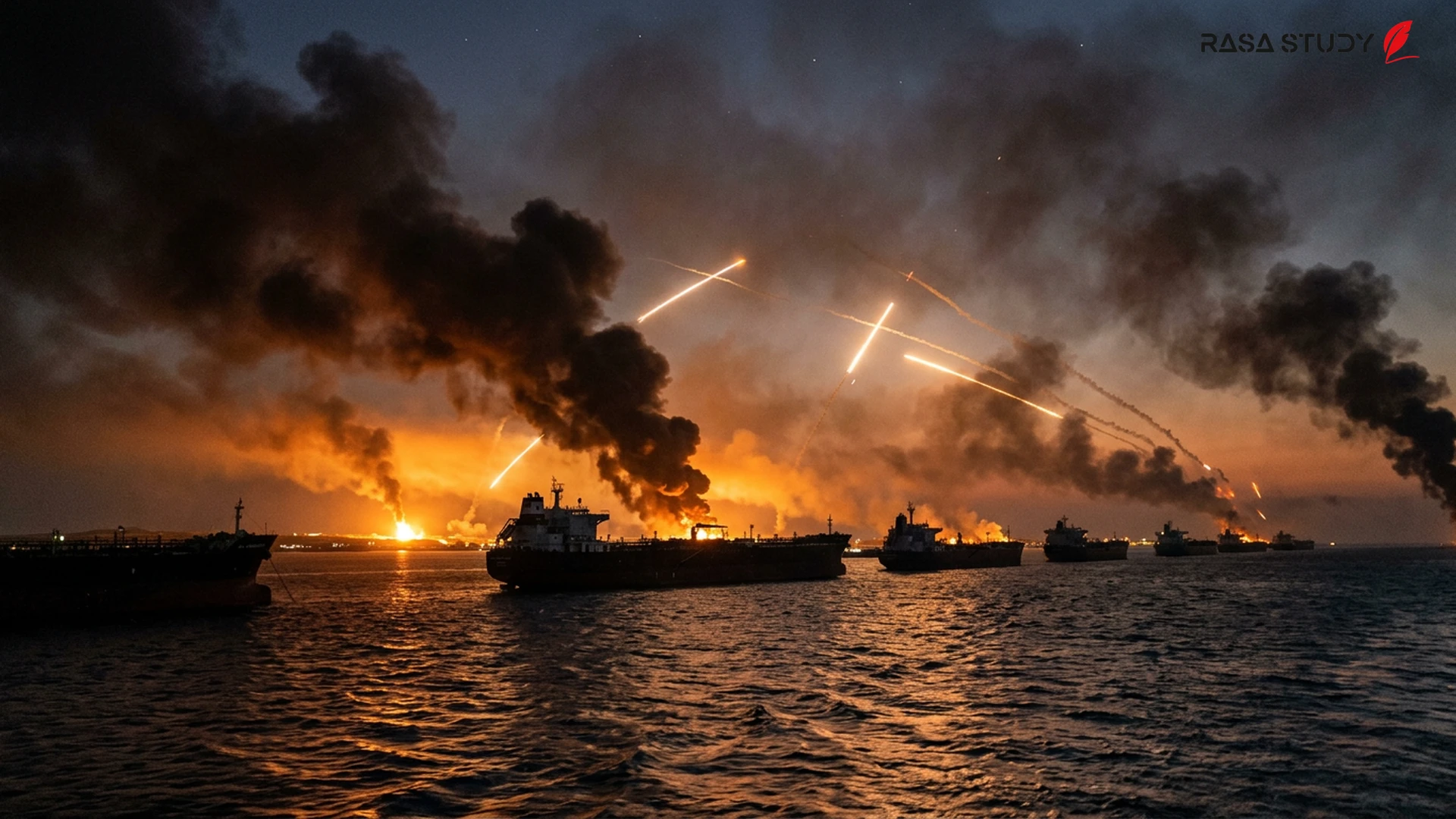
Following Iran's missile attack on targets in Qatar and the official announcement of the closure of the Strait of Hormuz on July 12, 2026, the Persian Gulf region has entered an unprecedented stage of military conflict, which analysts view as the end of diplomatic efforts.
Escalation of Tensions and Attacks on Qatar Bases In the early hours of today, July 12, 2026, reports from the Persian Gulf region indicate extensive missile and drone attacks by Iranian forces against targets on Qatari soil. According to the "Yeni Akit" newspaper, these attacks specifically targeted the Al-Udeid Air Base, which houses U.S. forces [1]. In an interview with the newspaper, Dr. Mehmet Mazhar Şahin described Iran's action in targeting Qatar as a "historic mistake" and "diplomatic ingratitude," as Qatar had played a key role in mediating between Tehran and Washington in recent months [1][3].
Closure of the Strait of Hormuz and the U.S. Reaction Simultaneously with these attacks, the Islamic Revolutionary Guard Corps (IRGC) officially announced that the Strait of Hormuz is closed to all maritime traffic until further notice [2]. This decision was made after CENTCOM forces, in response to an Iranian attack on a Cyprus-flagged container ship, bombed more than 140 military targets inside Iranian territory [4]. U.S. President Donald Trump issued a stern message stating that "the ceasefire is over" and that Iran will pay a heavy price for this "wrong choice" [4]. Currently, reports indicate that the movement of commercial vessels in this vital waterway, through which 20% of the world's oil passes, has completely stopped [2].
Emergency Situation in Qatar and Regional Countries In response to these attacks, the Qatari government has suspended all maritime and recreational activities on its coasts, calling these actions a "flagrant violation of international law" [3]. Reports show that shrapnel from missile interceptions in residential areas of Qatar has injured several civilians [2]. In addition to Qatar, Bahrain, the United Arab Emirates, and Oman have raised their military alert status to the highest possible level. The Qatari Ministry of Foreign Affairs stated that Iran will bear full legal responsibility and consequences for this escalation [2][3].
Geopolitical and Economic Consequences Analysts believe that the attack on Qatar, as one of Iran's close allies in recent years, indicates a shift in Tehran's strategy toward full-scale confrontation. This crisis, rooted in conflicts that began on February 28, 2026, has now hit the global energy market with a major shock [1][4]. Oil prices have seen an unprecedented jump in global markets, and marine insurance companies have canceled coverage for ships intending to enter the Persian Gulf. With the failure of recent agreements (such as the Islamabad Memorandum), the region appears to be on the brink of a widespread war that could transform the entire global energy security structure [2][4].
Military tensions in the Strait of Hormuz have caused a complete halt in commercial shipping and a jump in global energy prices.
linkSources
- “İran Katar’ı vurarak tarihi bir hata yaptı” Hürmüz Boğazı’nda kriz derinleşiyor — Yeni Akit Gazetesi (2026-07-12)
- US and Iran exchange strikes as Tehran declares strait of Hormuz closed again — The Guardian (2026-07-12)
- Qatar temporarily suspends all maritime activities amid US-Iran escalation — Anadolu Agency (2026-07-12)
- Trump declares Iran 'Cease Fire is OVER!' as US hits 140 targets — The Independent (2026-07-12)
- Iran Rejects Qatar's Claim over Strait of Hormuz Incident — Tasnim News Agency (2026-07-08)


