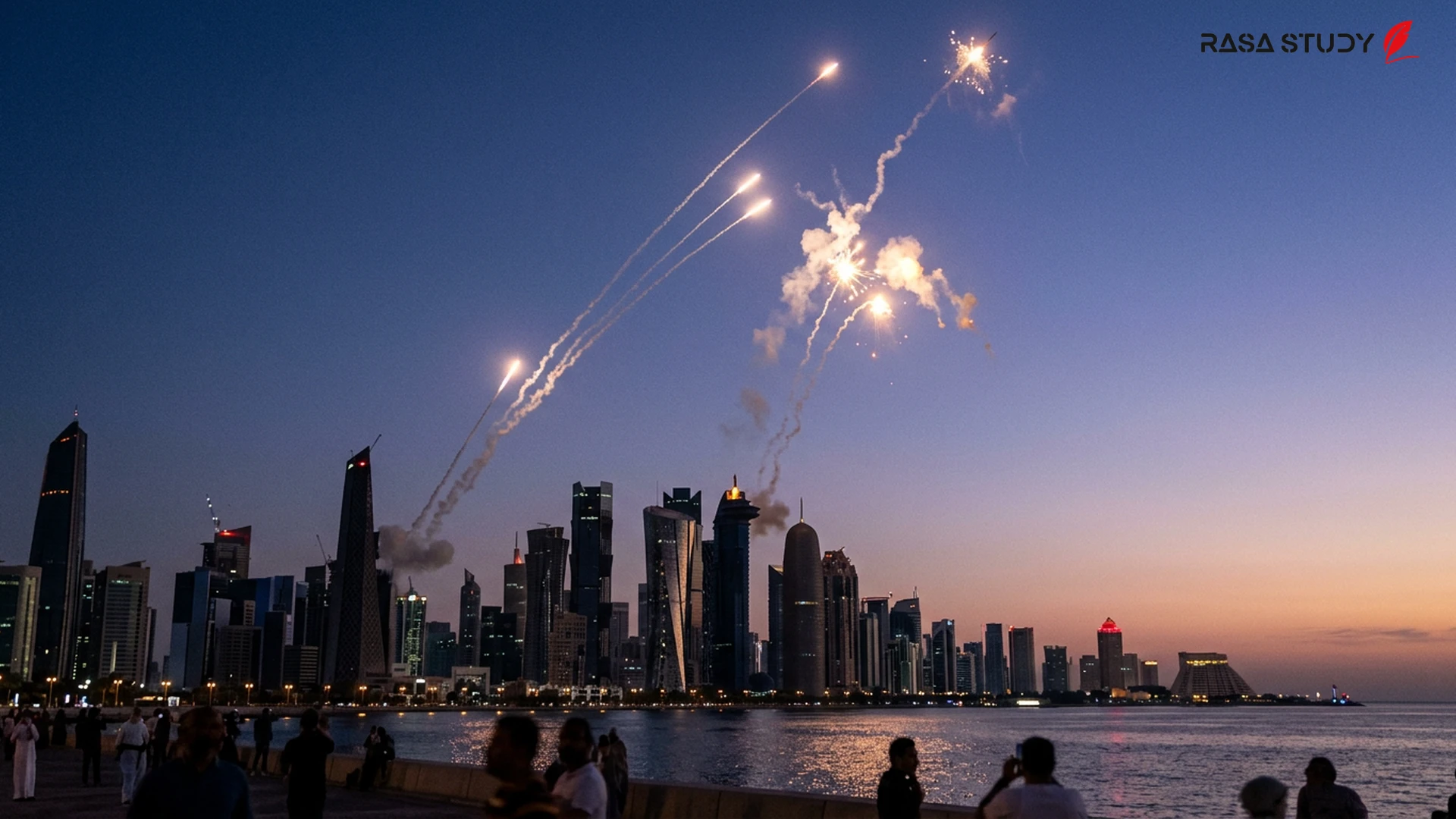
In the early hours of July 12, 2026, Qatar's air defense systems were activated to counter a massive wave of Iranian missile and drone attacks. These retaliatory strikes shook Doha and several other Gulf nations.
Details of Missile Attacks and Qatar's Air Defense Response
Following the escalation of military conflicts in the region, the skies over Doha witnessed massive explosions early this morning, July 12, 2026, caused by the activity of air defense systems. The Qatar Ministry of Defense confirmed that the country's defense systems successfully intercepted and destroyed several ballistic missiles fired from Iran [1]. The Qatar Ministry of Interior sent emergency alerts to citizens' mobile phones at 5:36 AM and 6:47 AM, urging them to take shelter in safe locations [2].
According to official reports, falling debris from the intercepted missiles in residential areas resulted in injuries to three people, including a child, who were immediately transported to medical centers for treatment [4]. Qatari security authorities and civil defense teams remain on full alert to protect public safety against potential subsequent threats.
Conflicting Claims Regarding Al-Udeid Air Base
Iran's Islamic Revolutionary Guard Corps (IRGC) claimed that during this operation, it targeted the Al-Udeid Air Base in Qatar, which houses US forces. Iranian-affiliated media claimed that a fighter jet maintenance center and a command and control unit at the base were destroyed [2]. However, the Qatar Ministry of Defense, while confirming the interception of the missiles, declined to confirm any serious damage to the base and emphasized the ability of its armed forces to protect the country's territorial integrity [3].
Escalation of the Crisis in the Persian Gulf and Blockade of the Strait of Hormuz
These attacks occurred just hours after the United States conducted its third round of heavy strikes against 140 military targets in southern Iran, including radar and missile sites [4]. In response to these actions and citing "foreign intervention," Iran has declared the Strait of Hormuz closed until further notice [5]. In addition to Qatar, Bahrain, Kuwait, and the United Arab Emirates were also targeted by similar attacks, indicating the expansion of the conflict's dimensions to the entire region [3].
International Reactions and Regional State of Emergency
Simultaneously with this military crisis, Qatar faced two other somber events: the passing of Sheikh Hamad bin Khalifa Al Thani, the former Emir of Qatar, and the sudden death of prominent US Senator Lindsey Graham, which has further impacted the region's political atmosphere [4]. Analysts believe that the blockade of the Strait of Hormuz and direct attacks on Gulf Cooperation Council member states have brought mediation efforts for a ceasefire to a serious deadlock and endangered the stability of global energy markets [3].
Qatar's air defense systems countering Iranian missile attacks in the early hours of July 12, 2026.
linkSources
- Katar’daki hava savunma sistemleri, İran’ın misilleme füzelerine karşılık verdi — Milliyet (2026-07-12)
- Qatar confirms three injuries after intercepting Iranian ballistic missiles — Doha News (2026-07-12)
- Iran attacks Qatar, Bahrain, Kuwait, Oman, Jordan and UAE after fresh US strikes — Arab News (2026-07-12)
- Qatar says 3 injured by falling debris after intercepting Iranian attacks — Anadolu Agency (2026-07-12)
- İran'dan misilleme: Katar ve Bahreyn bombalandı — Analiz Gazetesi (2026-07-12)


