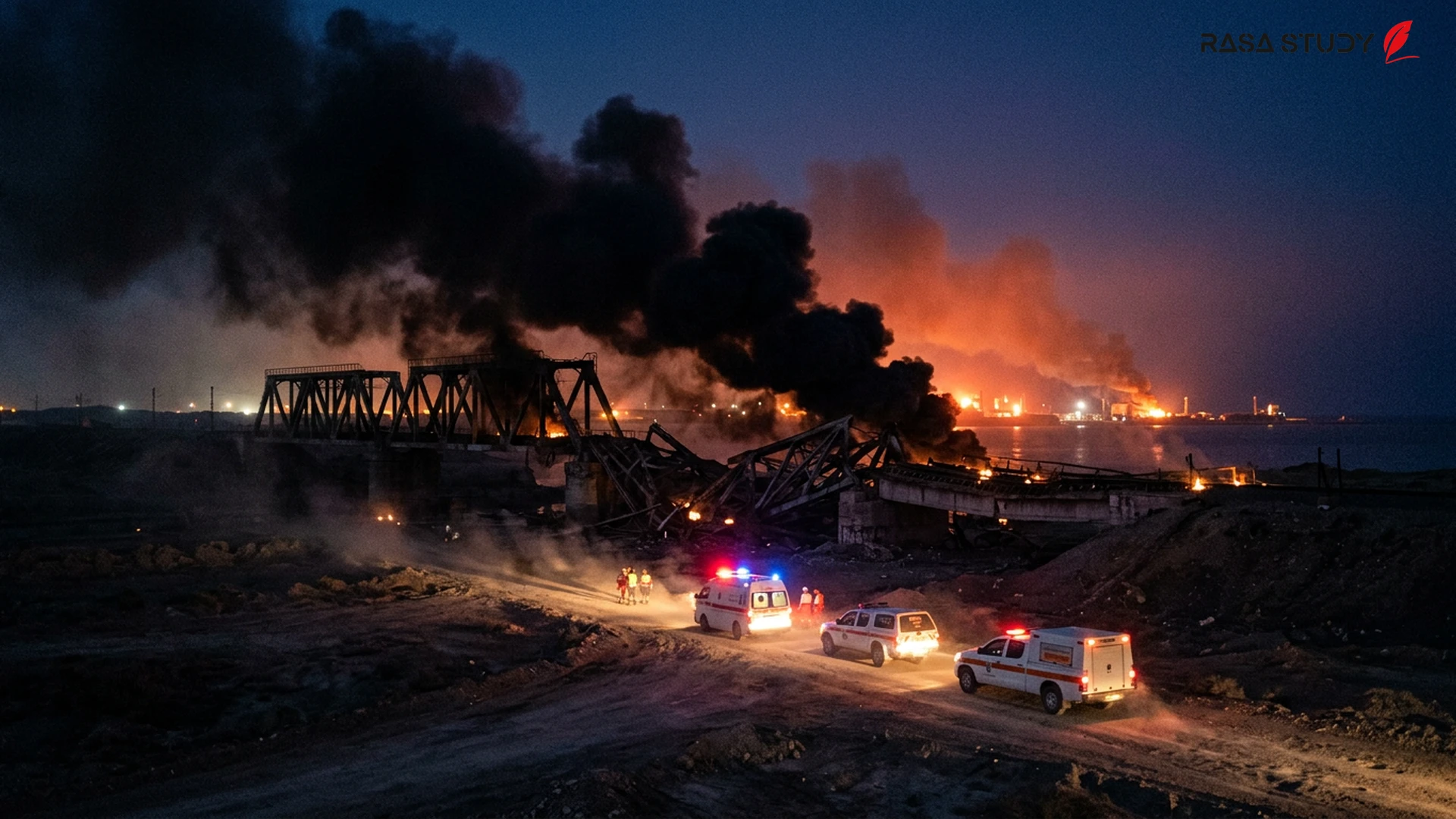
Following direct orders from President Trump, the United States military conducted extensive airstrikes against targets in Iranian territory for the seventh consecutive night. These attacks have been met with retaliatory missile and drone strikes by Iran against US-allied bases in the region.
Details of the Seventh Night of Attacks and CENTCOM Targets The United States Central Command (CENTCOM) has officially announced the completion of the seventh consecutive night of military operations against Iran. According to the CENTCOM statement, these attacks, conducted using fighter jets, drones, and warships, targeted surveillance sites, military logistics infrastructure, underground weapons depots, and Iranian naval capabilities [2][4]. Local reports from Iran indicate that several strategic bridges in Hormozgan Province, the Bandar Khamir railway station, and Iranshahr Airport were hit, resulting in the deaths of at least 7 people [1][4].
Iran's Retaliatory Response at the Regional Level In response to these attacks, Iranian military forces launched a wave of drone and missile attacks against United States bases and its allies in neighboring countries. Kuwaiti officials reported that Iranian drones damaged a power plant and a desalination facility, and several soldiers were wounded at Camp Udairi and Ali Al Salem Air Base [1][3]. Additionally, the Bahraini military announced that its air defense systems intercepted several drone attacks on Sheikh Isa Air Base, which houses US forces [3]. Jordan also reported the interception and destruction of 10 Iranian missiles in its airspace [1].
Crisis in the Strait of Hormuz and Threat of "All-Out Offensive" Tensions in the Strait of Hormuz have reached their peak. The Islamic Revolutionary Guard Corps (IRGC) claimed that two tankers exploded in this international waterway due to contact with mines, a claim that CENTCOM immediately denied [1][3]. Furthermore, Iran has announced that it has prevented the passage of four ships in the area. Major General Mohsen Rezaei, senior military advisor to Iran's leader, warned that if US attacks continue for another two or three days, Tehran will enter the phase of "all-out offensive operations," emphasizing that no political borders in the region will be safe anymore [3][4].
Humanitarian and Infrastructure Consequences The recent airstrikes have put severe pressure on civilian infrastructure. Iran's Ministry of Energy has asked citizens to minimize electricity consumption and the use of cooling systems, as the country's power grid has come under pressure from attacks on energy facilities [1]. Meanwhile, the international community is watching with concern as the diplomatic agreements of last month collapse, and the Middle East region is now in its most sensitive military state in decades [4].
United States airstrikes on targets in southern Iran continued for the seventh consecutive night.
linkSources
- US launches seventh night of Iran strikes as Hormuz conflict escalates — The Guardian (2026-07-18)
- U.S. concludes 7th consecutive night of strikes on Iran, CENTCOM says — CBS News (2026-07-18)
- Iran warns of 'full-scale offensive' if US strikes continue — Gulf News (2026-07-18)
- US military says it completed latest strikes on Iran, marking 7th consecutive night of attacks — Reuters via KFGO (2026-07-17)


