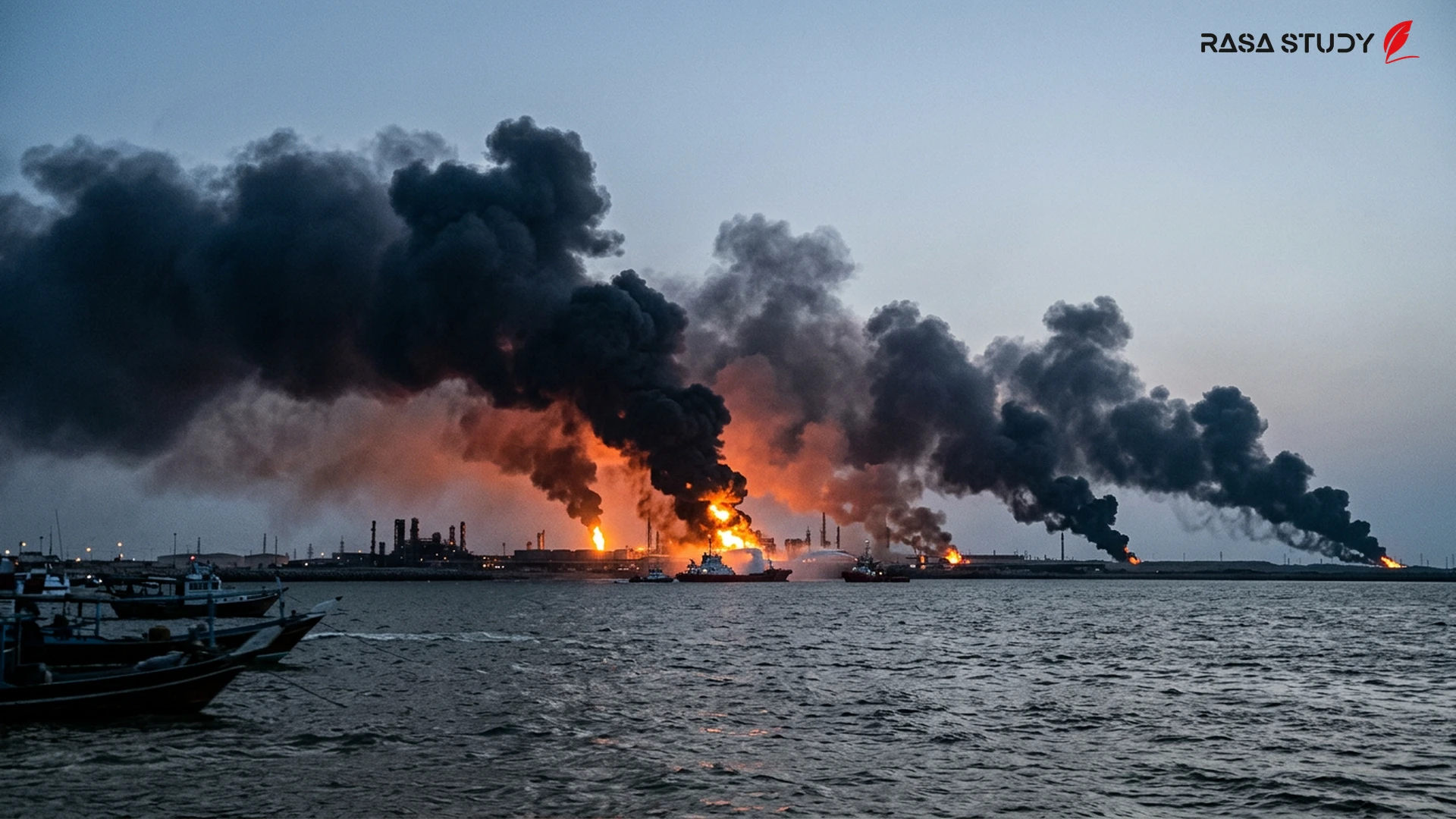
Following the collapse of a temporary ceasefire agreement, US forces launched a large-scale operation targeting several Iranian coastal cities, including Bushehr, Mahshahr, and Abadan, resulting in serious damage to energy infrastructure.
Details of CENTCOM's Five-Hour Operation Against Military Targets United States Central Command (CENTCOM) officially announced that it has concluded a new wave of airstrikes and missile attacks against military targets across southern Iran. This operation, which lasted approximately five hours, targeted strategic cities such as Bushehr, Chabahar, Jask, Konarak, and Bandar Abbas [1]. According to the CENTCOM statement, these attacks were carried out with the aim of reducing Iran's capabilities to threaten commercial shipping in the Strait of Hormuz, utilizing high-precision weaponry to destroy missile sites, drone facilities, and coastal defense systems [4].
Bushehr, Abadan, and Mahshahr at the Center of Attacks Local reports and official Iranian news agencies have confirmed that the city of Bushehr, which hosts the country's only active nuclear power plant, witnessed hostile projectiles striking four different locations [2]. Although provincial officials stated that the nuclear facility itself was not damaged, massive explosions were heard in surrounding areas, including Choghadak [3]. Simultaneously, in Khuzestan province, the deputy governor for security affairs reported attacks on points in Abadan County and near Mahshahr [1]. Abadan, home to the oldest oil refinery in the Middle East, and Mahshahr, as Iran's petrochemical hub, were key targets in this wave of attacks, indicating Washington's focus on Iran's economic arteries [5].
Iran's Missile Response and Counterattacks on Regional Bases In response to this aggression, the Islamic Revolutionary Guard Corps and the Army of the Islamic Republic of Iran announced the start of retaliatory operations. Reports indicate the firing of several ballistic missiles and suicide drones toward US logistical and air bases in Jordan, Kuwait, and Bahrain [3]. Jordan confirmed that it intercepted at least four Iranian missiles in its airspace [1]. This direct exchange of fire has sounded the alarm for a widespread regional war and triggered air defense systems across the Persian Gulf nations [4].
Collapse of the Ceasefire and Diplomatic Deadlock These bloody clashes occur just one month after the signing of a temporary peace memorandum in June 2026. US President Donald Trump, announcing the official end of the ceasefire, claimed that Iran had not adhered to its commitments and announced the re-establishment of a "naval blockade" on Iran [5]. In contrast, the Islamic Consultative Assembly of Iran, presenting a double-urgency plan for the management of the Strait of Hormuz, has deemed any cooperation by regional countries with Washington as an "act of war" [4]. Experts believe that given Trump's upcoming speech on July 16, the likelihood of attacks expanding to more critical Iranian infrastructure in the coming days is very high [5].
Thick smoke resulting from missile attacks on the coastal areas of Bushehr on July 15, 2026
linkSources
- US strikes hit locations in Iran's southwestern provinces: Officials — Anadolu Agency (2026-07-14)
- Four sites in Bushehr targeted by US strikes, Iranian official says — Middle East Eye (2026-07-14)
- آخرین اخبار حملات آمریکا به خاک وطن در ۲۳ و ۲۴ تیرماه — Tasnim News Agency (2026-07-14)
- US says latest Iran strike wave over, IRGC claims damage to US Naval HQ — Al Jazeera (2026-07-15)
- Strikes on Bushehr Nuclear Plant and Abadan Refinery Amid Retaliatory Attacks — The Chosun Daily (2026-07-15)


